
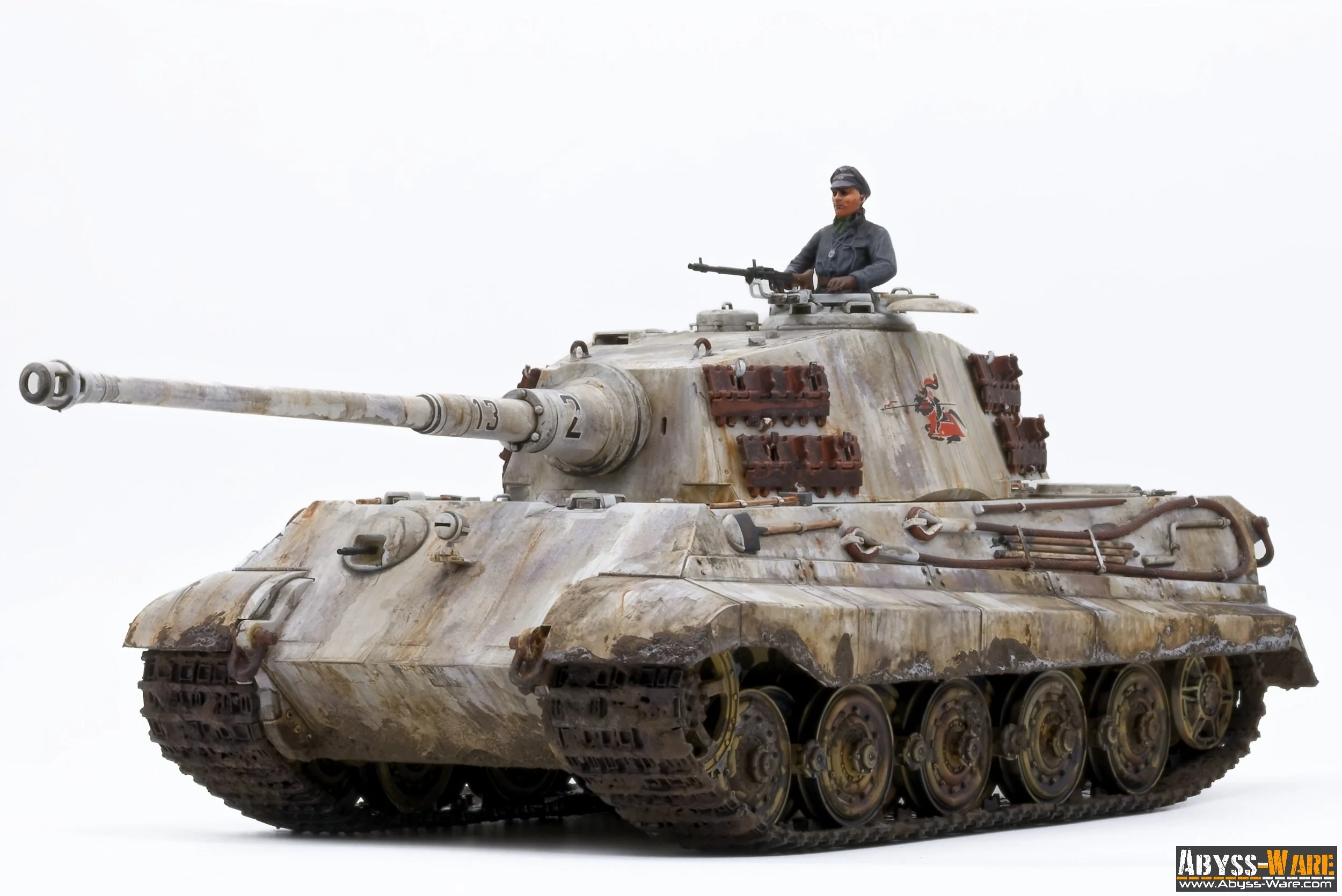
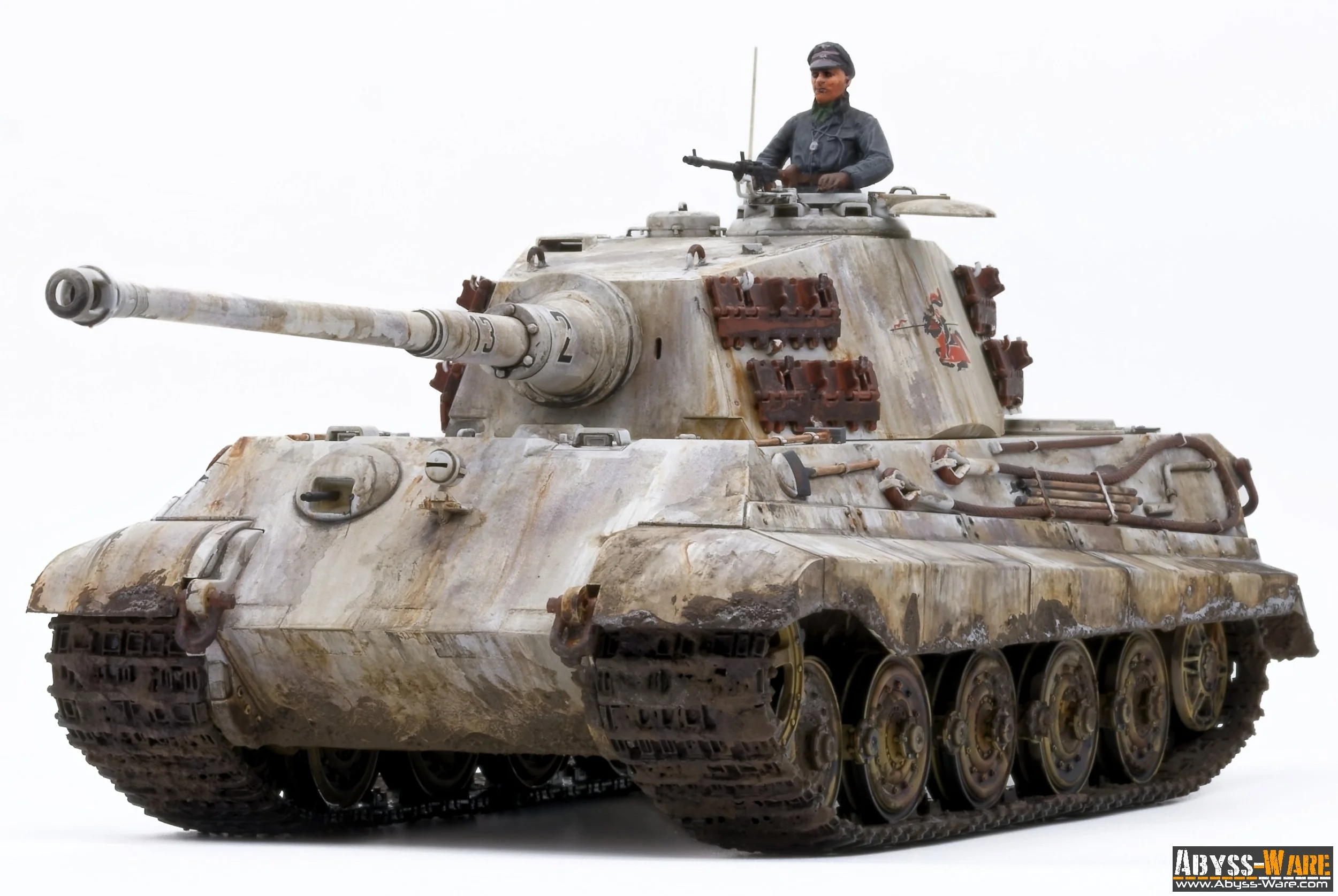
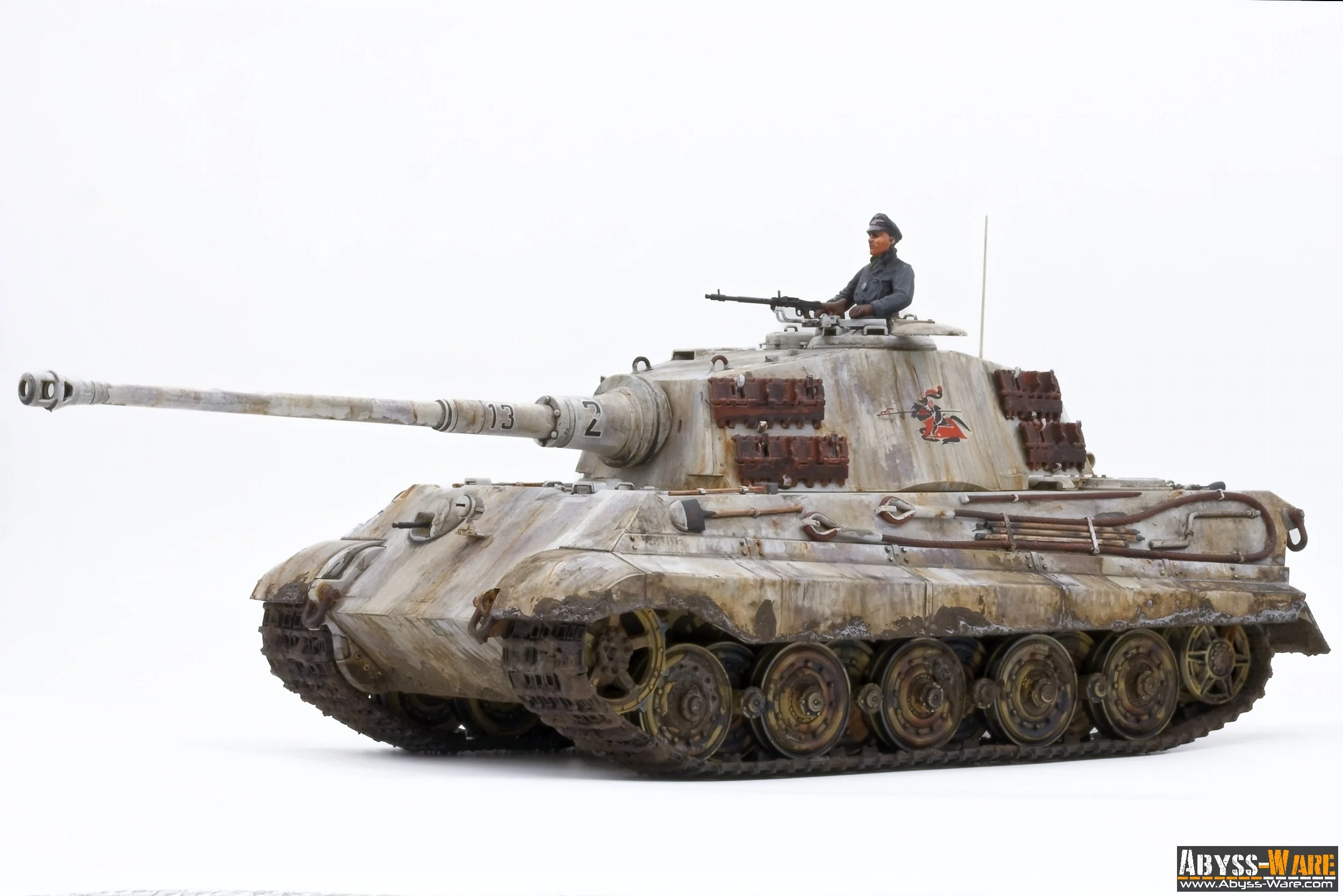
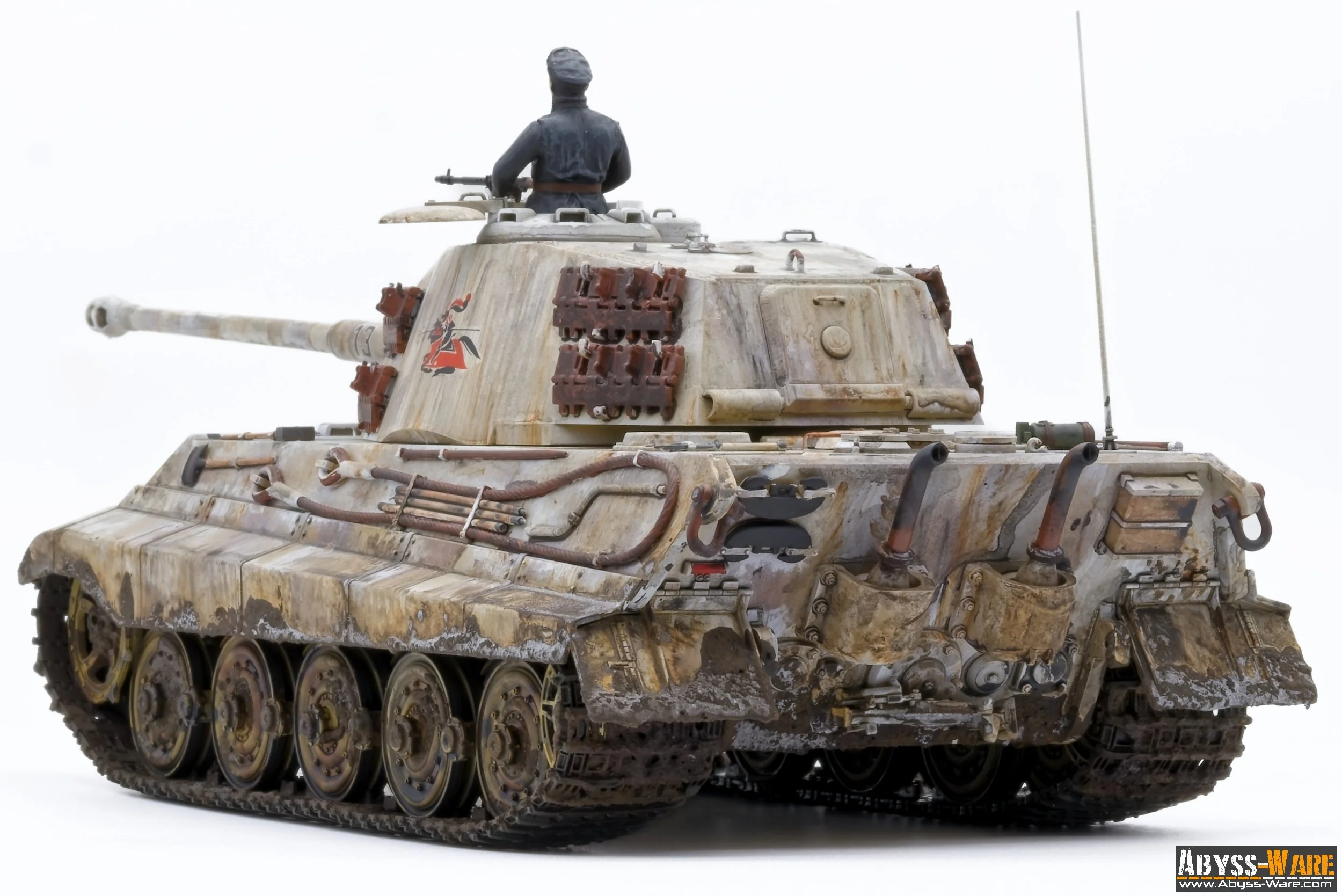
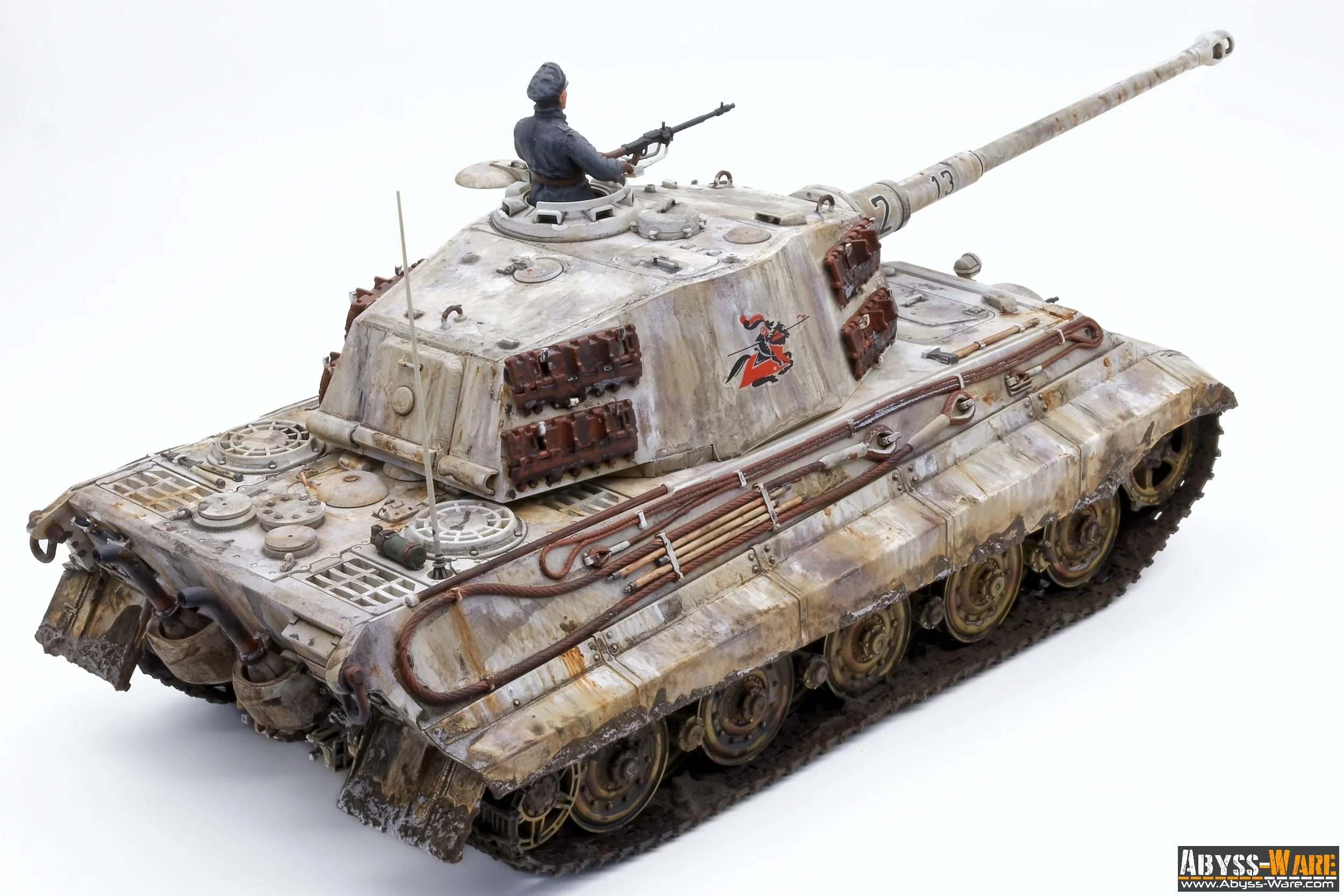
Panzer Kmpf. VI - KONIGSTIGER - Sd.Kfz.182
TAMIYA 35164
SCALE 1/35
.
;
The King Tiger, officially known as the Panzerkampfwagen VI Ausf. B Tiger II, stands as a formidable symbol of German engineering during the latter half of World War II. Its imposing presence and devastating firepower struck fear into the hearts of Allied tank crews, earning it a legendary, almost mythical status on the battlefield. Development of the King Tiger began in 1942, driven by the need for a heavily armored tank capable of countering the increasingly capable Soviet and Allied designs. Henschel and Porsche both submitted prototypes, with Henschel's design ultimately being selected for production. The first King Tigers rolled off the assembly line in early 1944.
What immediately set the King Tiger apart was its armor. The front glacis plate was a staggering 150mm thick and sloped at 50 degrees, providing exceptional protection against most Allied anti-tank guns. The turret front was 180mm thick, making it virtually impenetrable from the front. This heavy armor, however, came at a significant cost: weight. Tipping the scales at nearly 69 metric tons, the King Tiger was one of the heaviest tanks of its era, which often led to mechanical breakdowns and logistical challenges. Its primary armament was the fearsome 8.8 cm KwK 43 L/71 gun, a longer and more powerful variant of the gun found on the earlier Tiger I. This gun was capable of penetrating the frontal armor of almost any Allied tank at long ranges, giving the King Tiger a significant advantage in engagements. Allied tankers quickly learned that a direct frontal assault against a King Tiger was often a suicidal endeavor. Despite its impressive specifications, the King Tiger's operational history was a mixed bag. Its immense weight and complex engineering meant it was prone to mechanical issues, especially with its transmission and final drives. Fuel consumption was also exorbitant, placing a further strain on Germany's already dwindling resources. Furthermore, the limited number produced – only around 492 were built – meant they could never truly stem the tide of the overwhelming Allied forces. King Tigers saw action on both the Eastern and Western Fronts, participating in major battles such as the Battle of the Bulge and the defense of Berlin. While individual tanks often achieved remarkable kill ratios, their impact was localized and temporary.
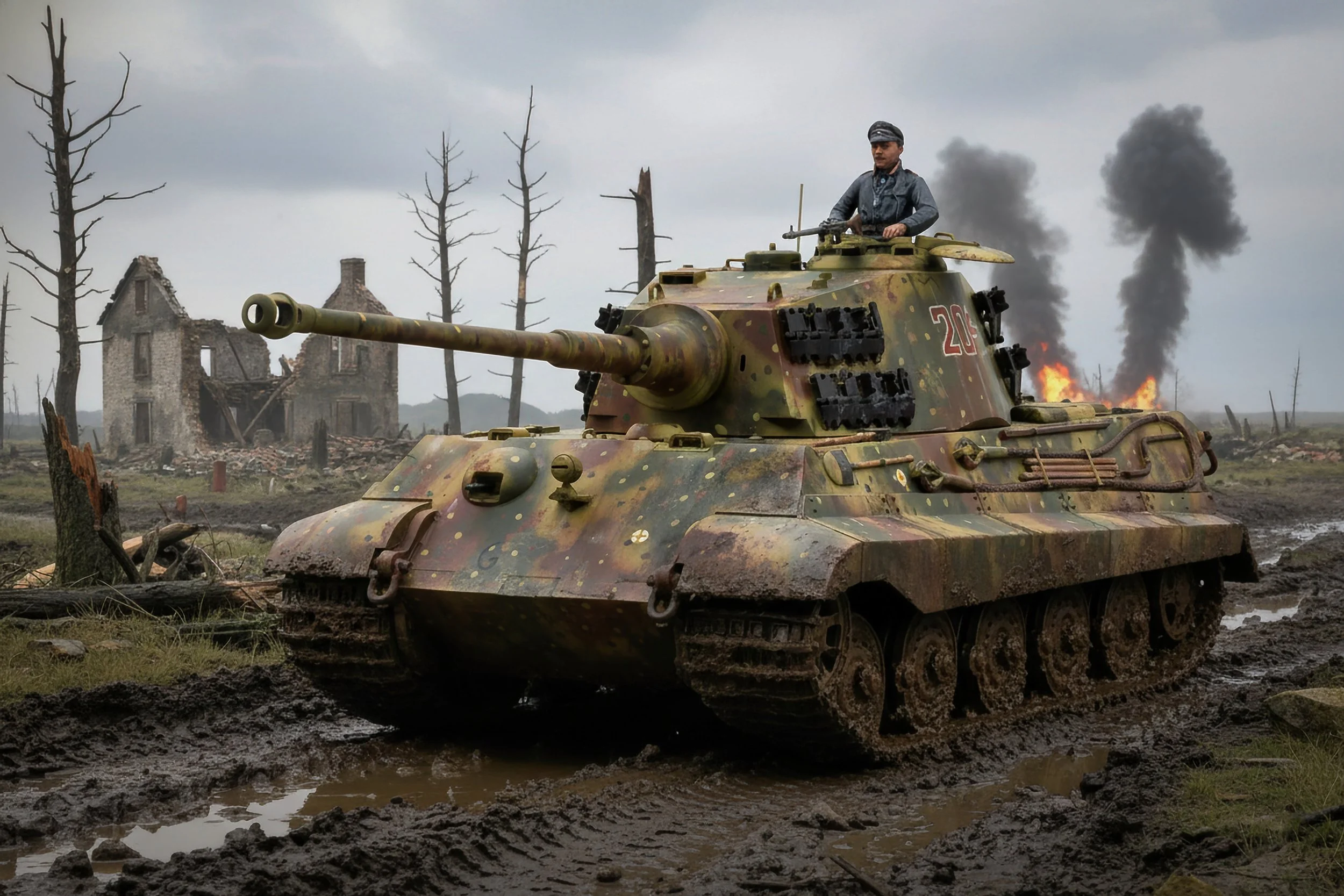
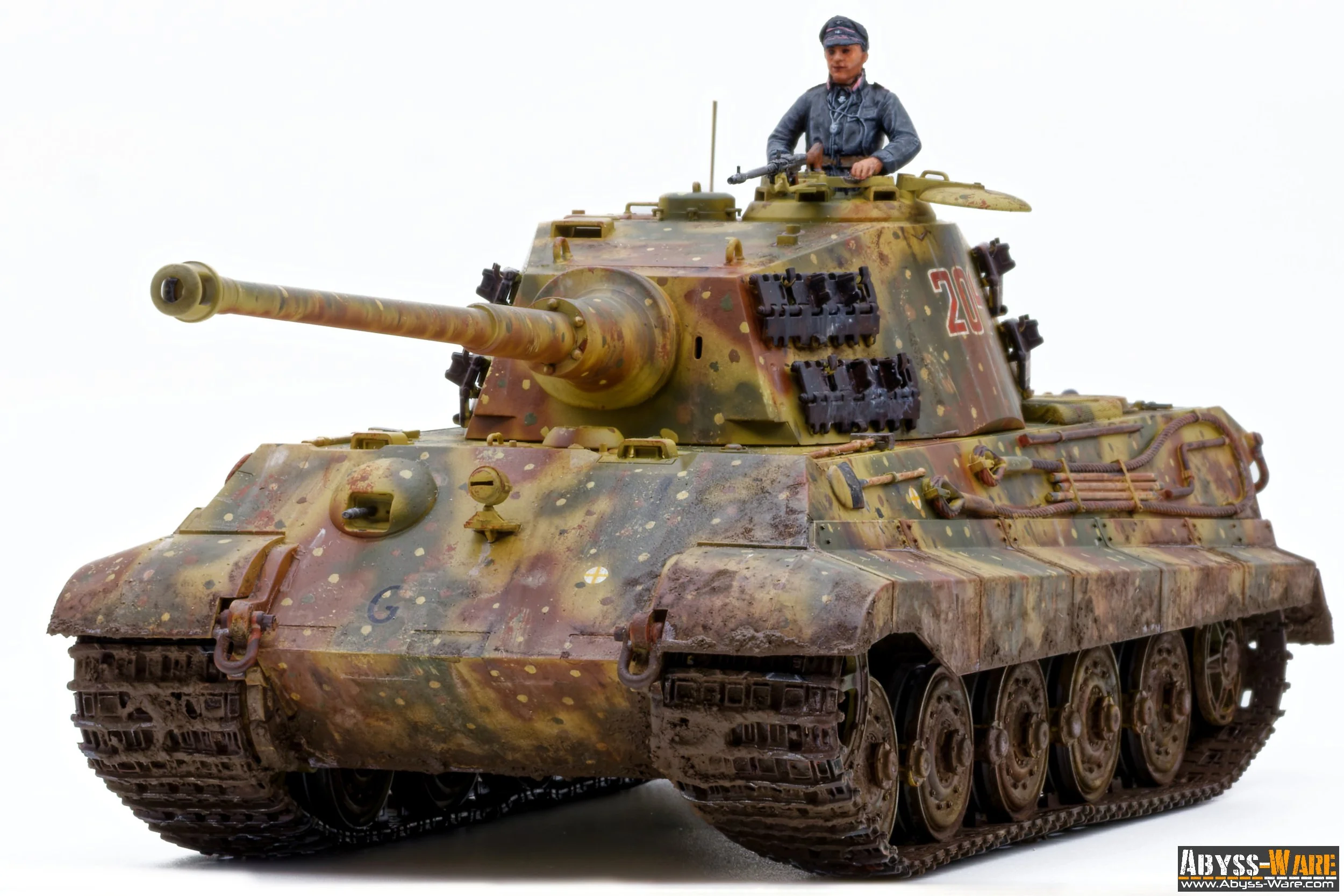
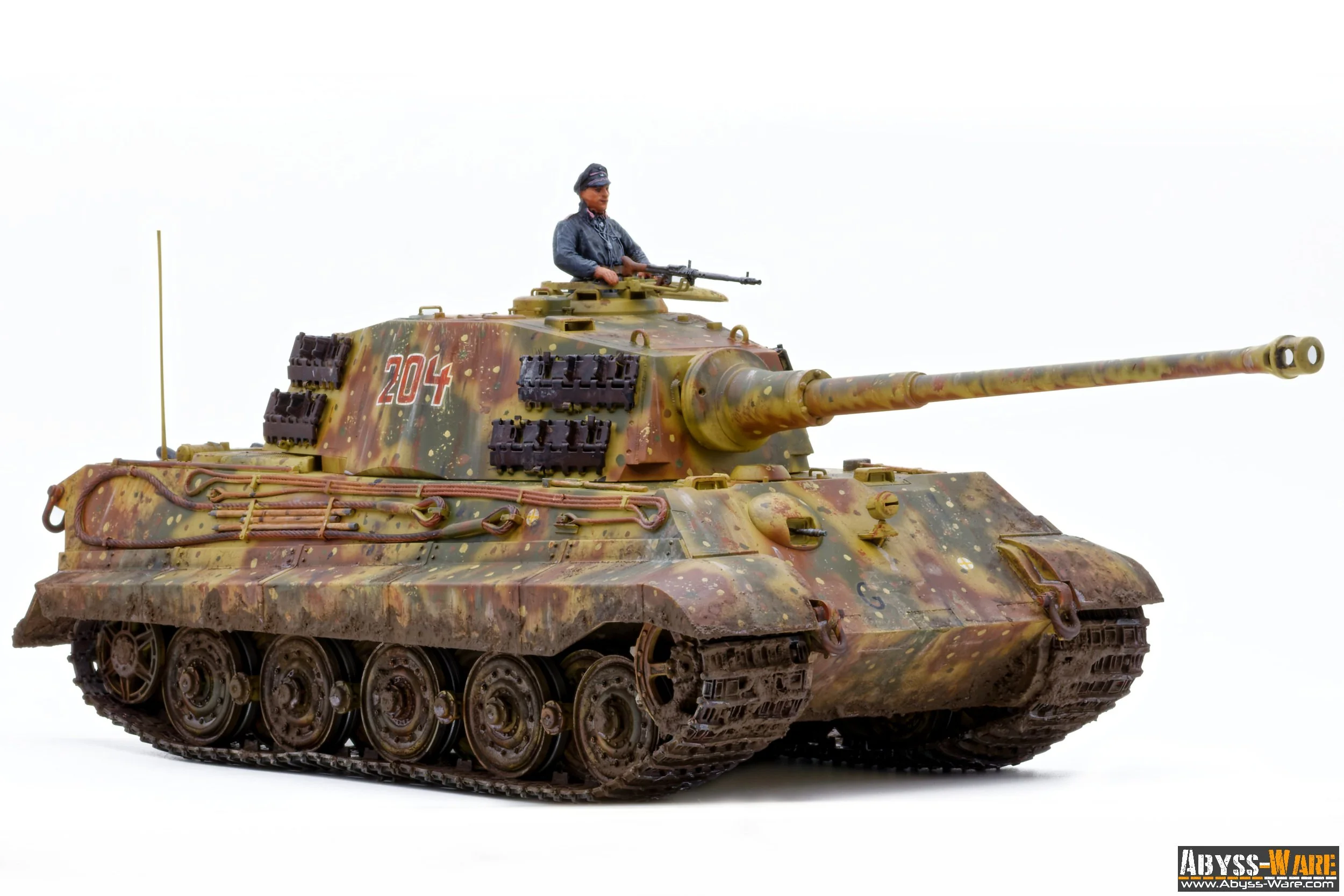
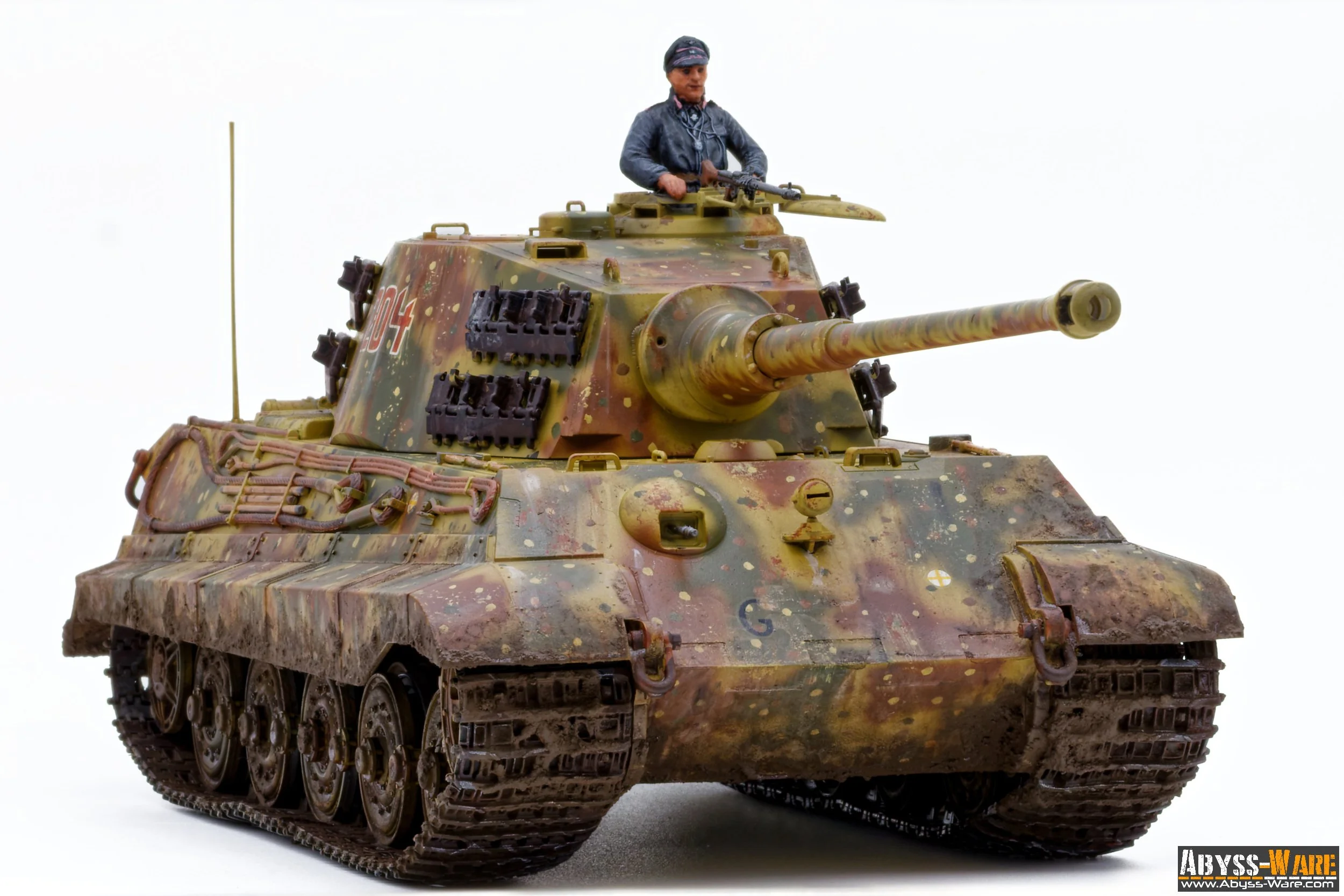
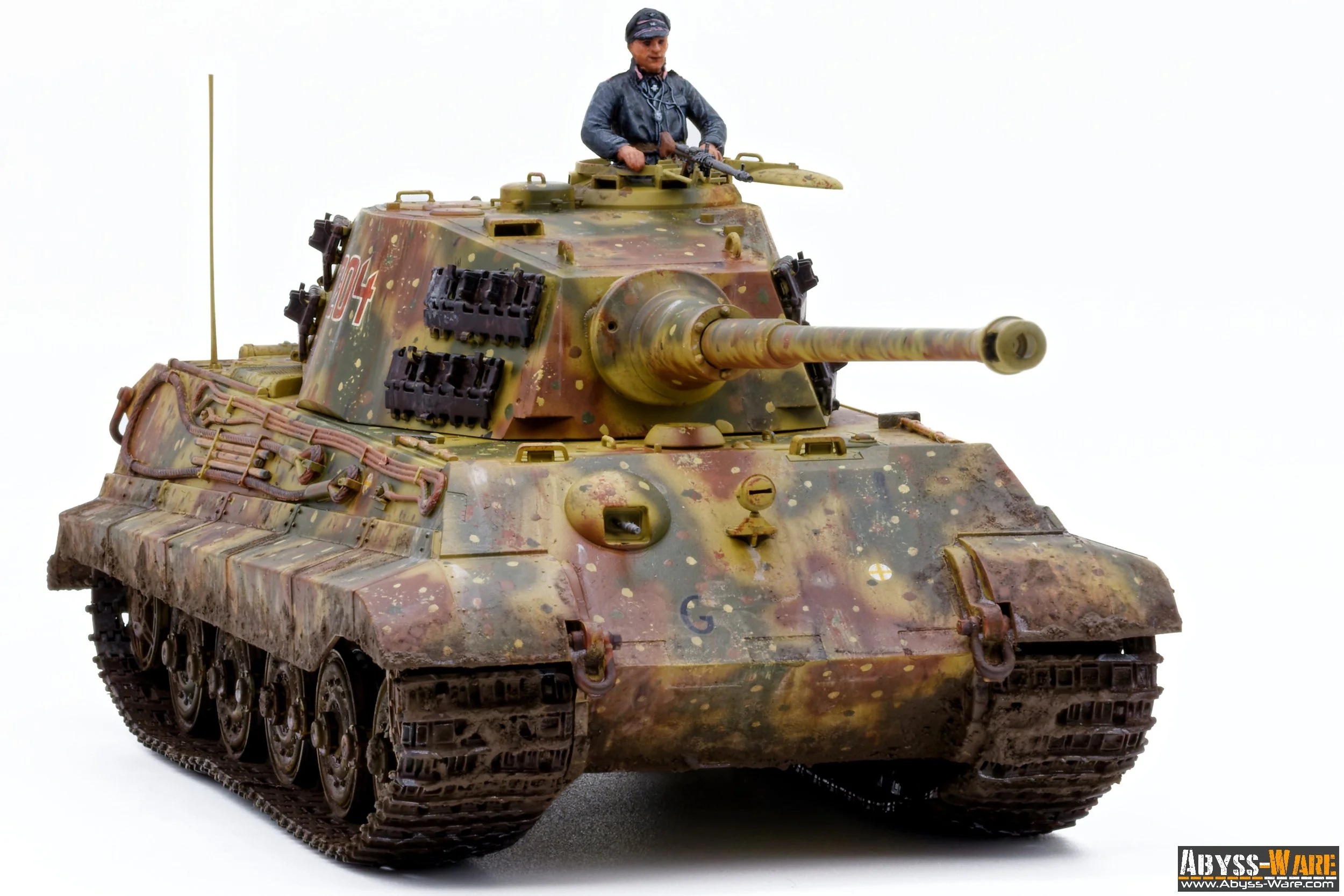
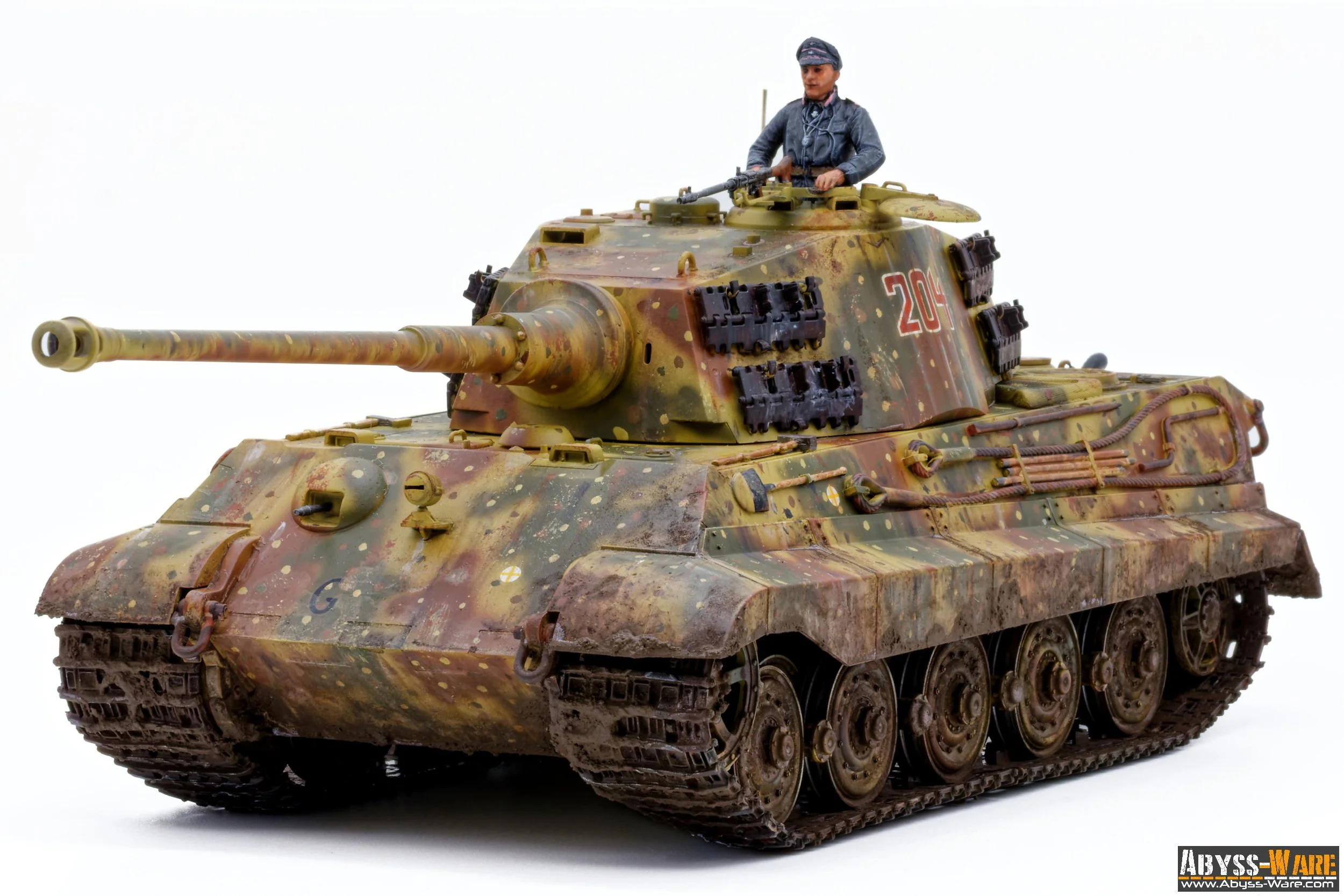
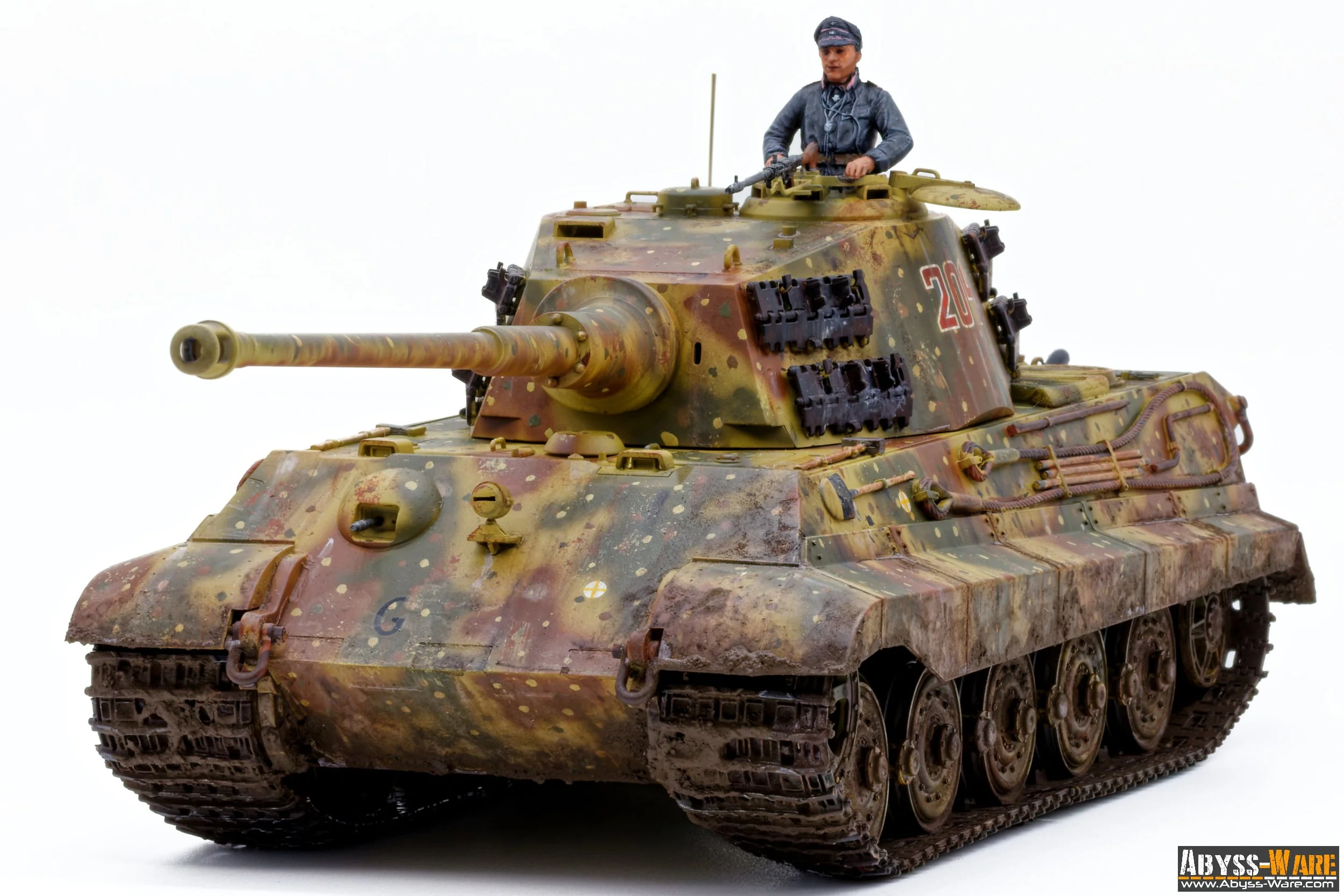
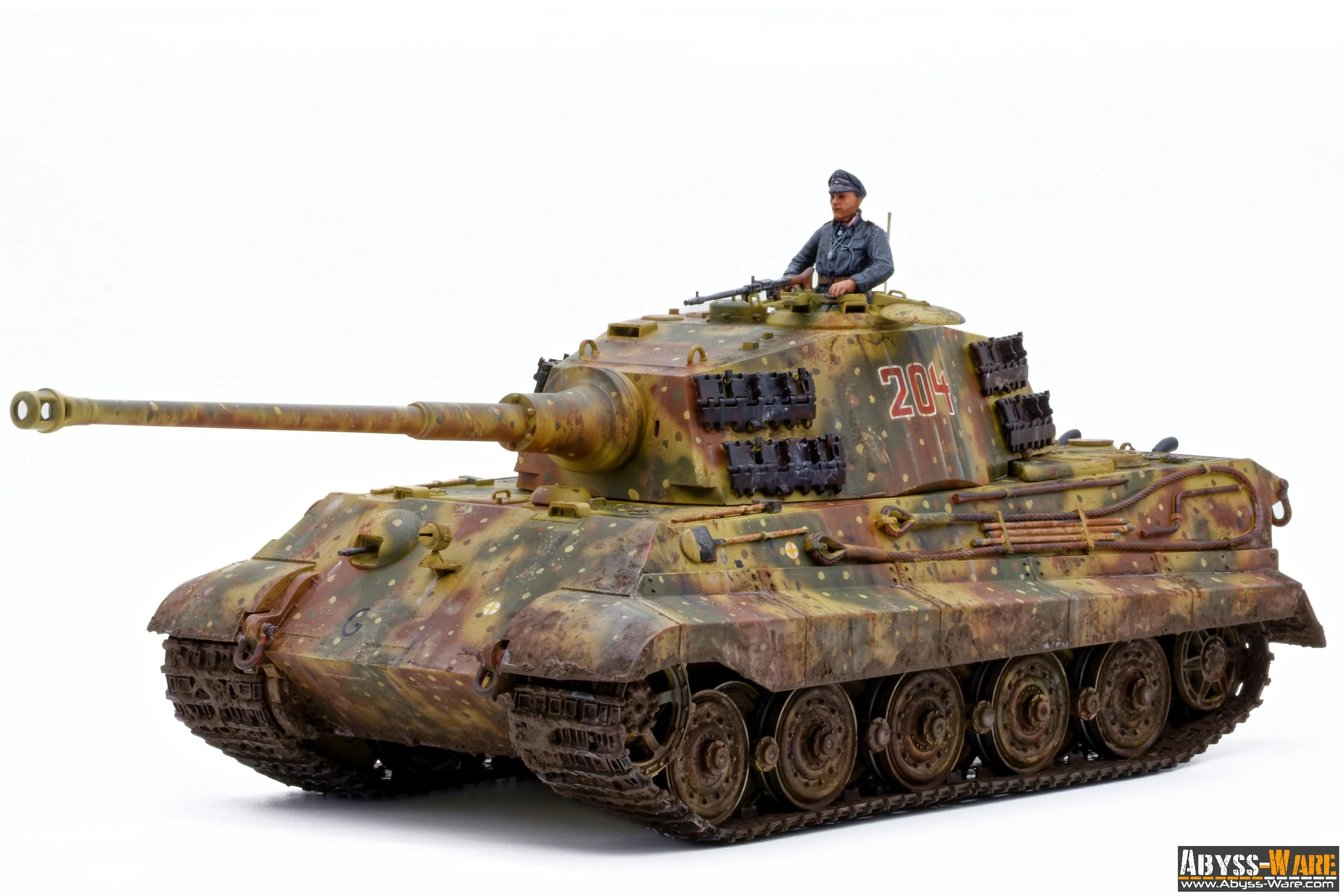
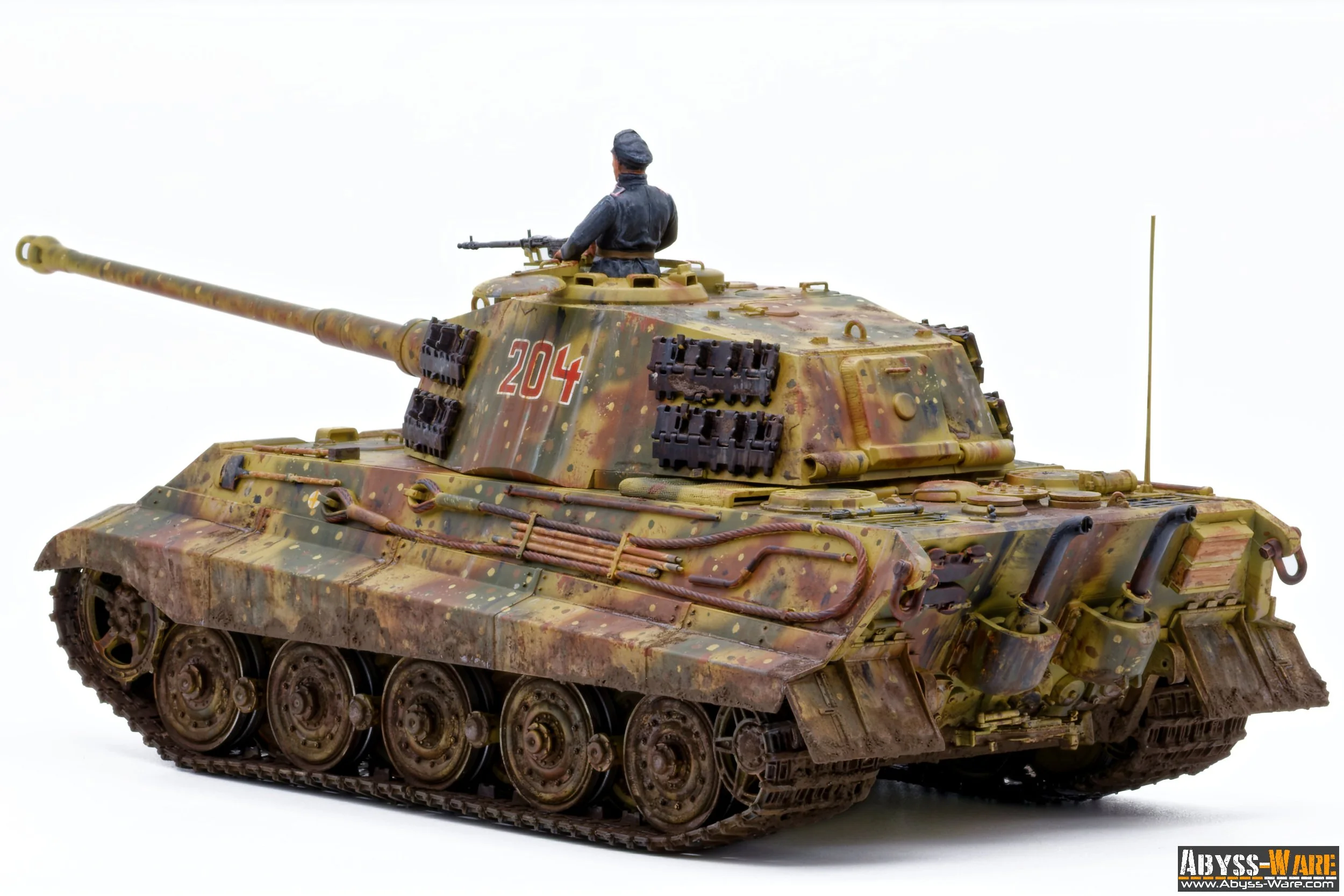
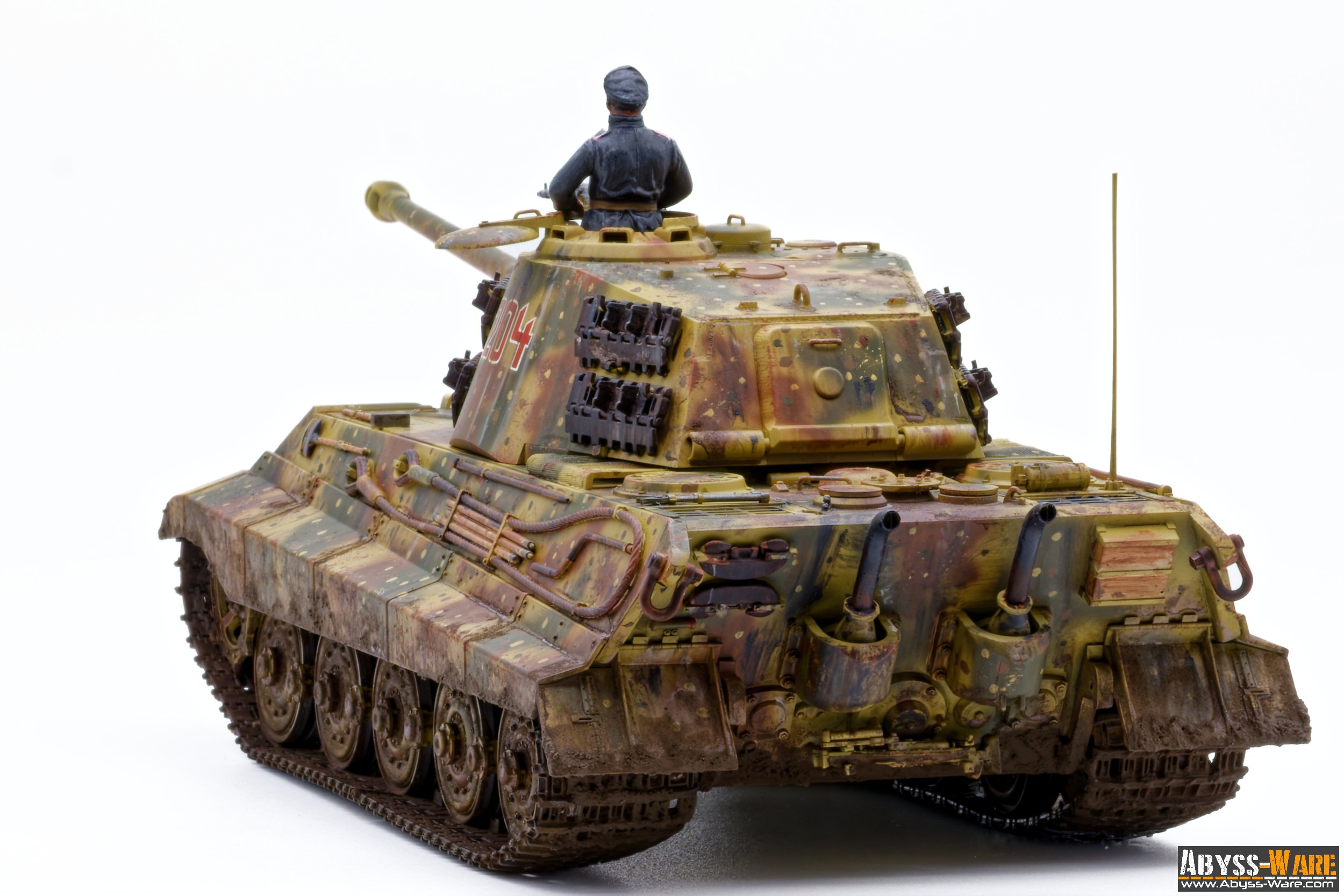
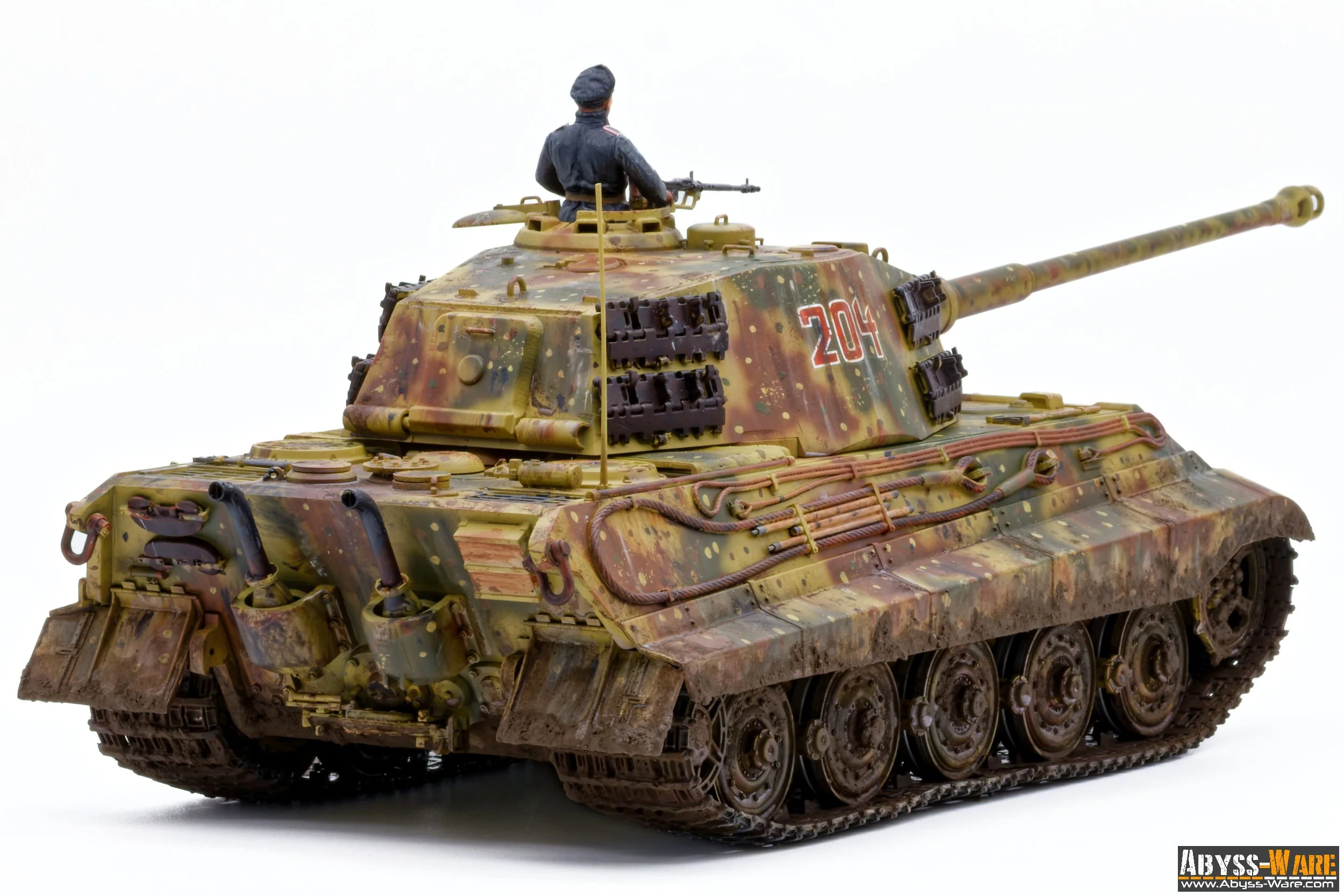
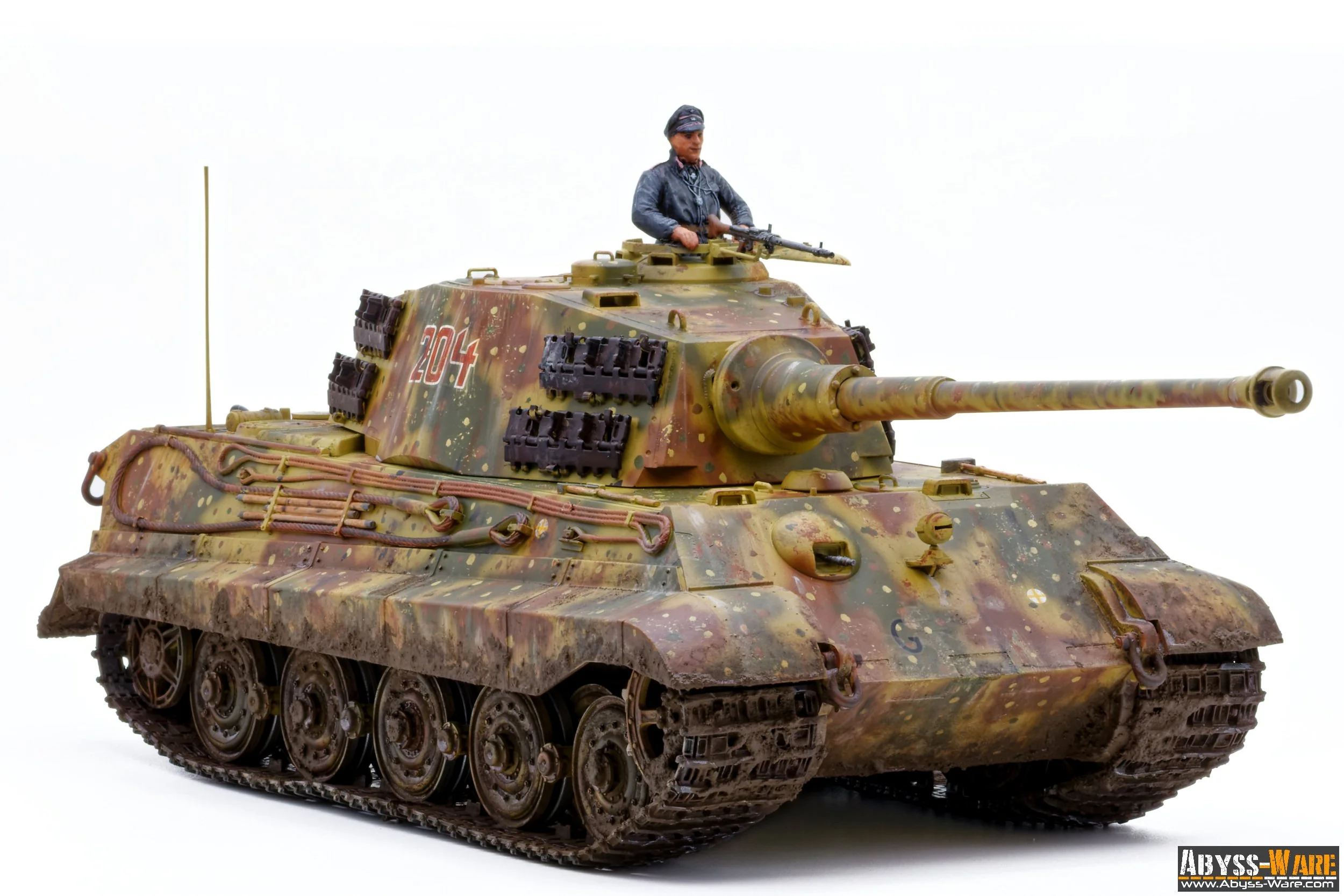
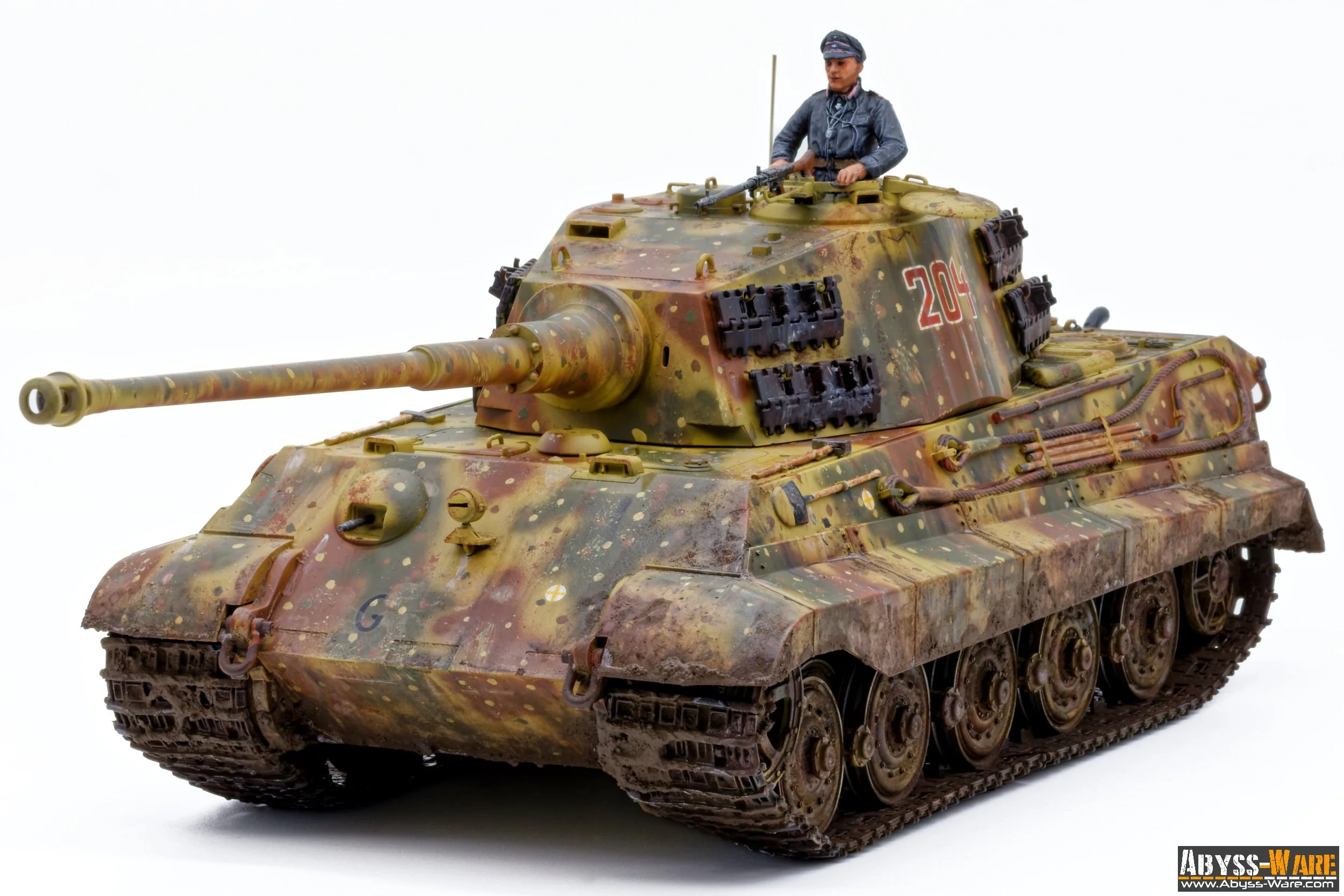
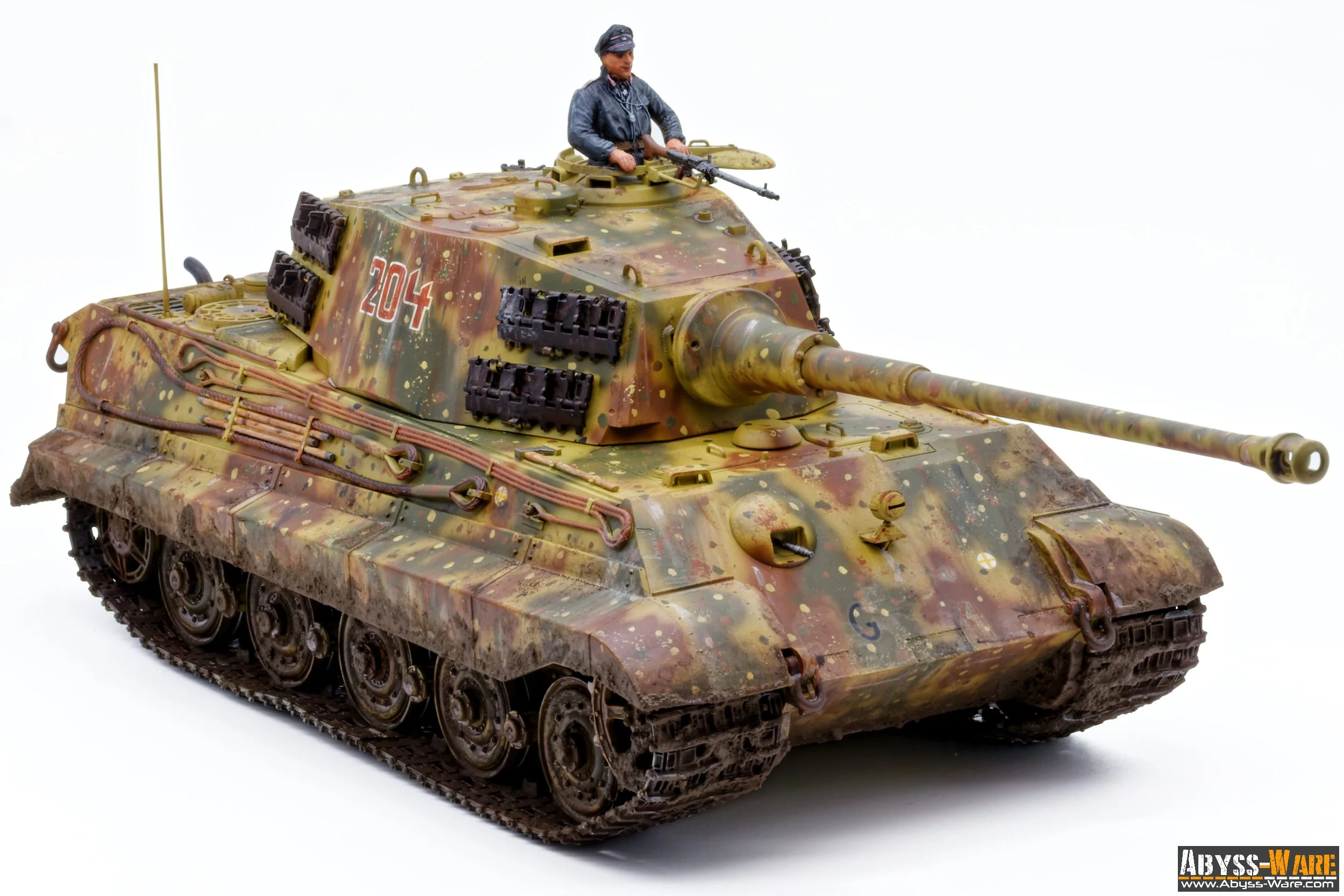
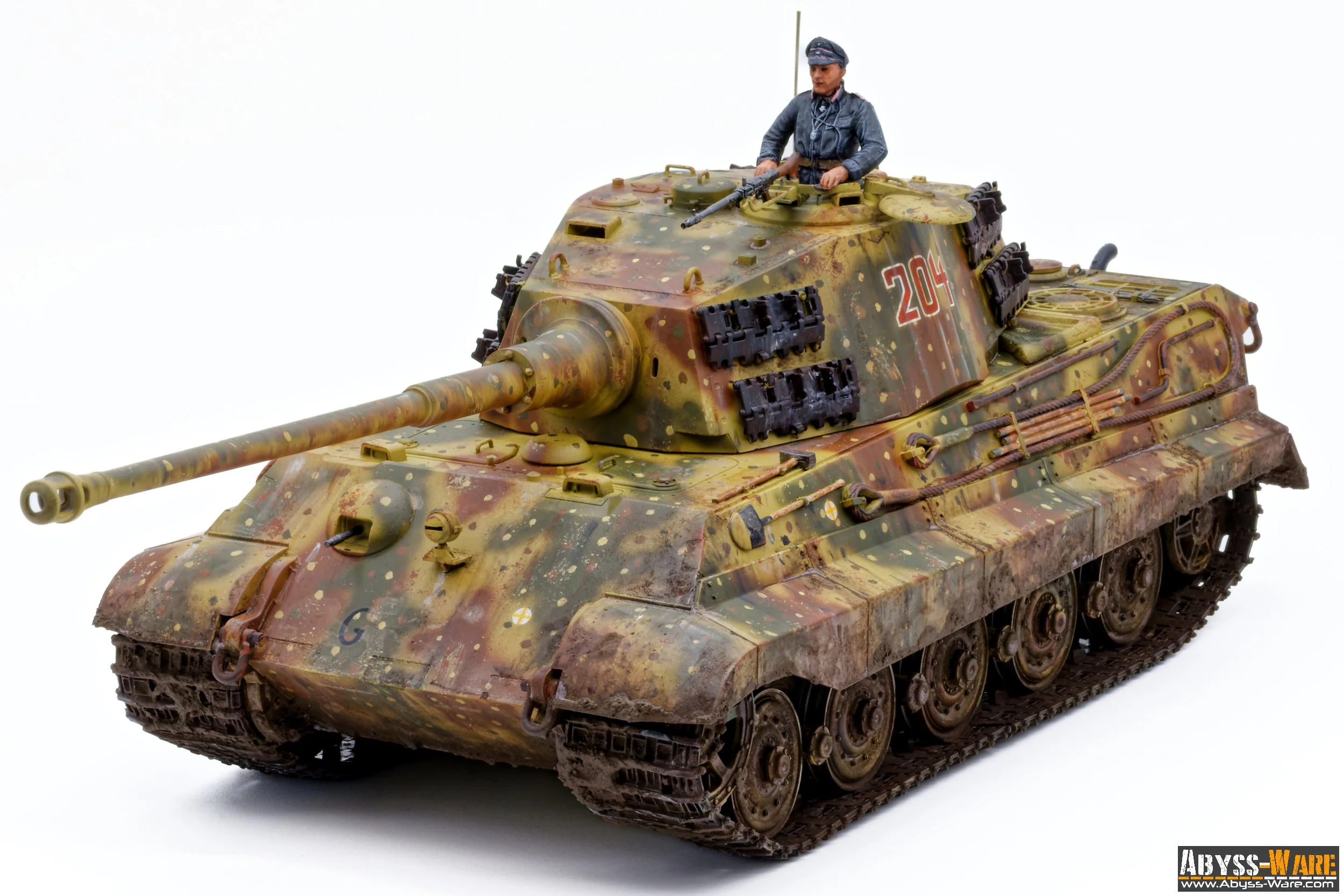
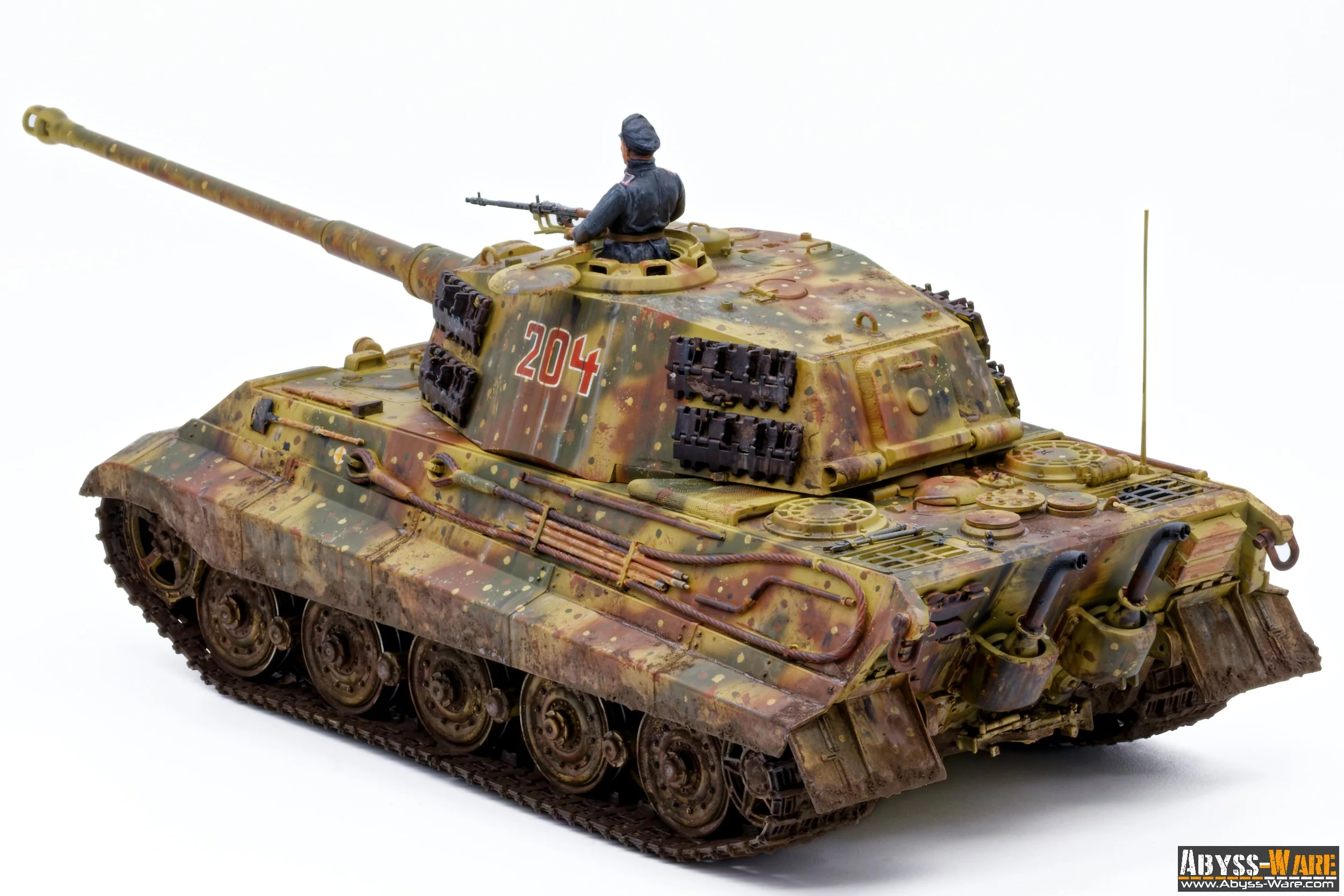
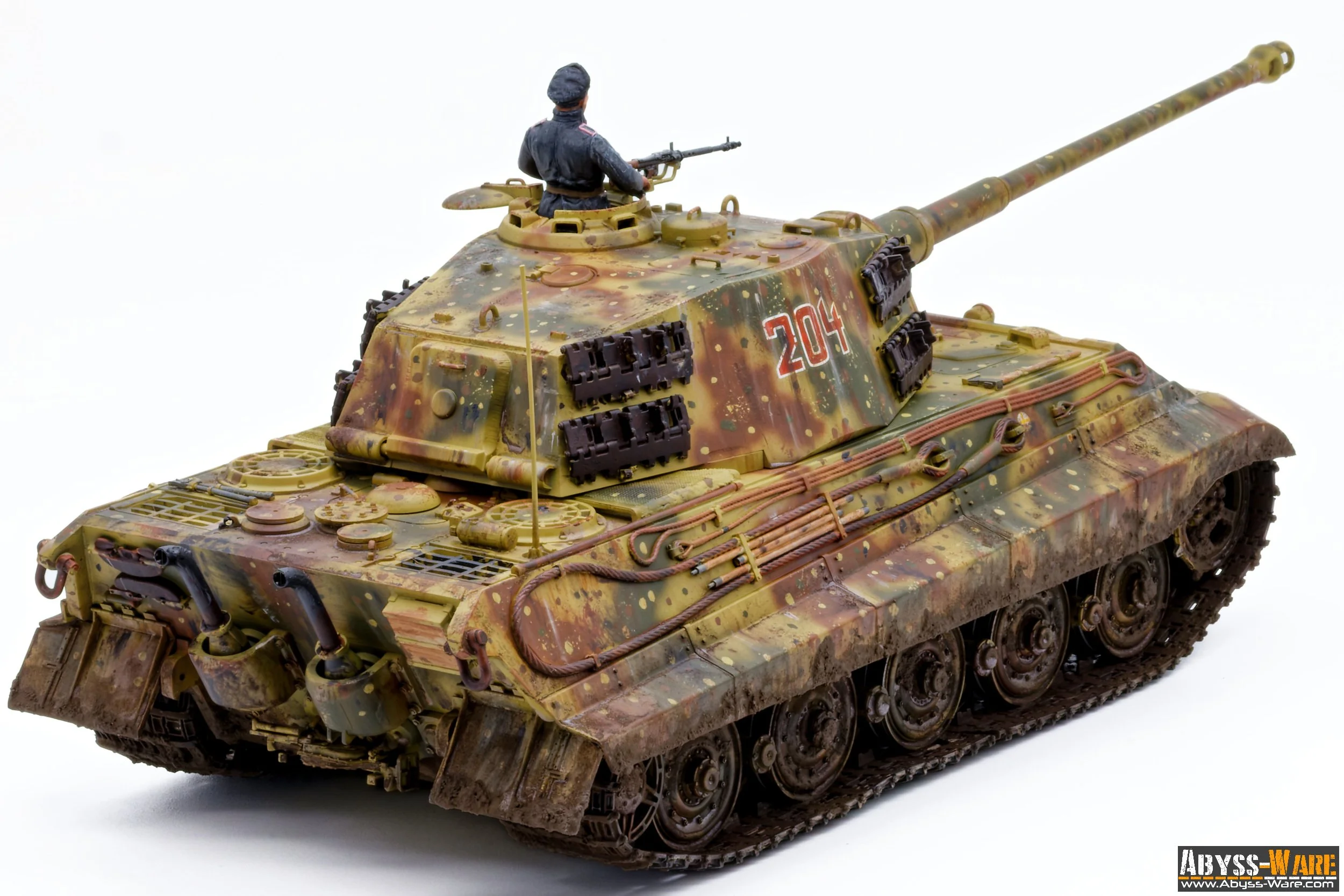
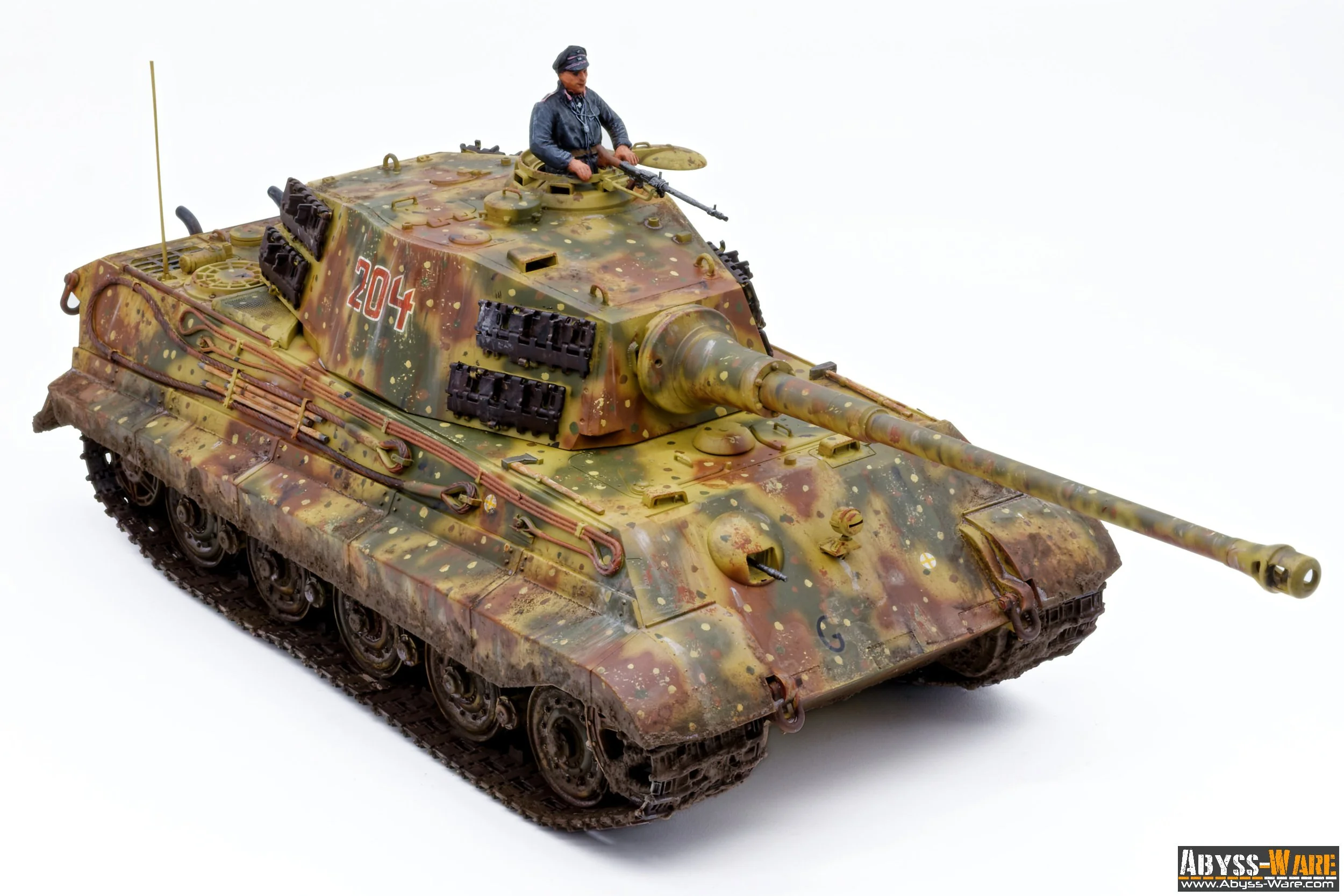
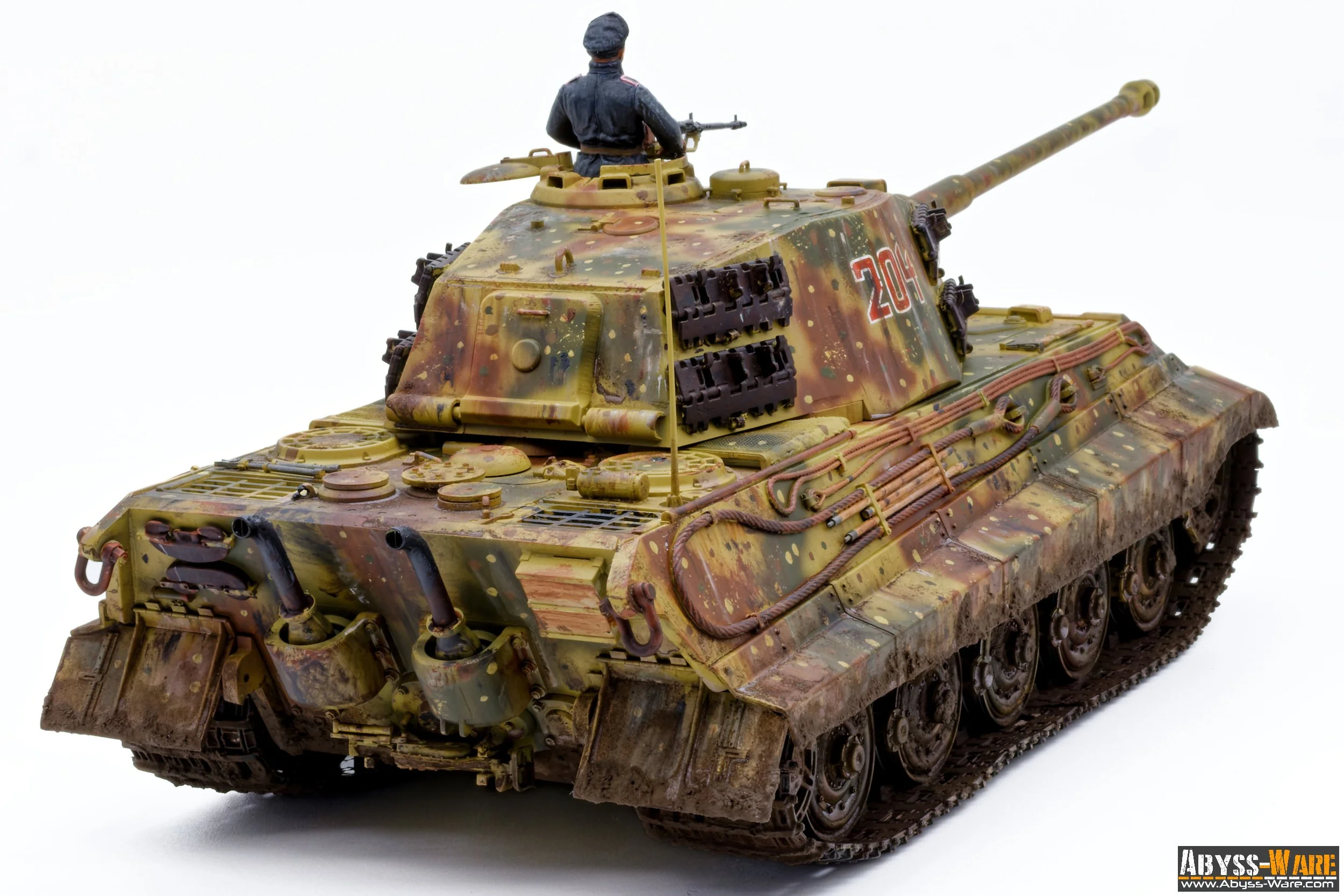
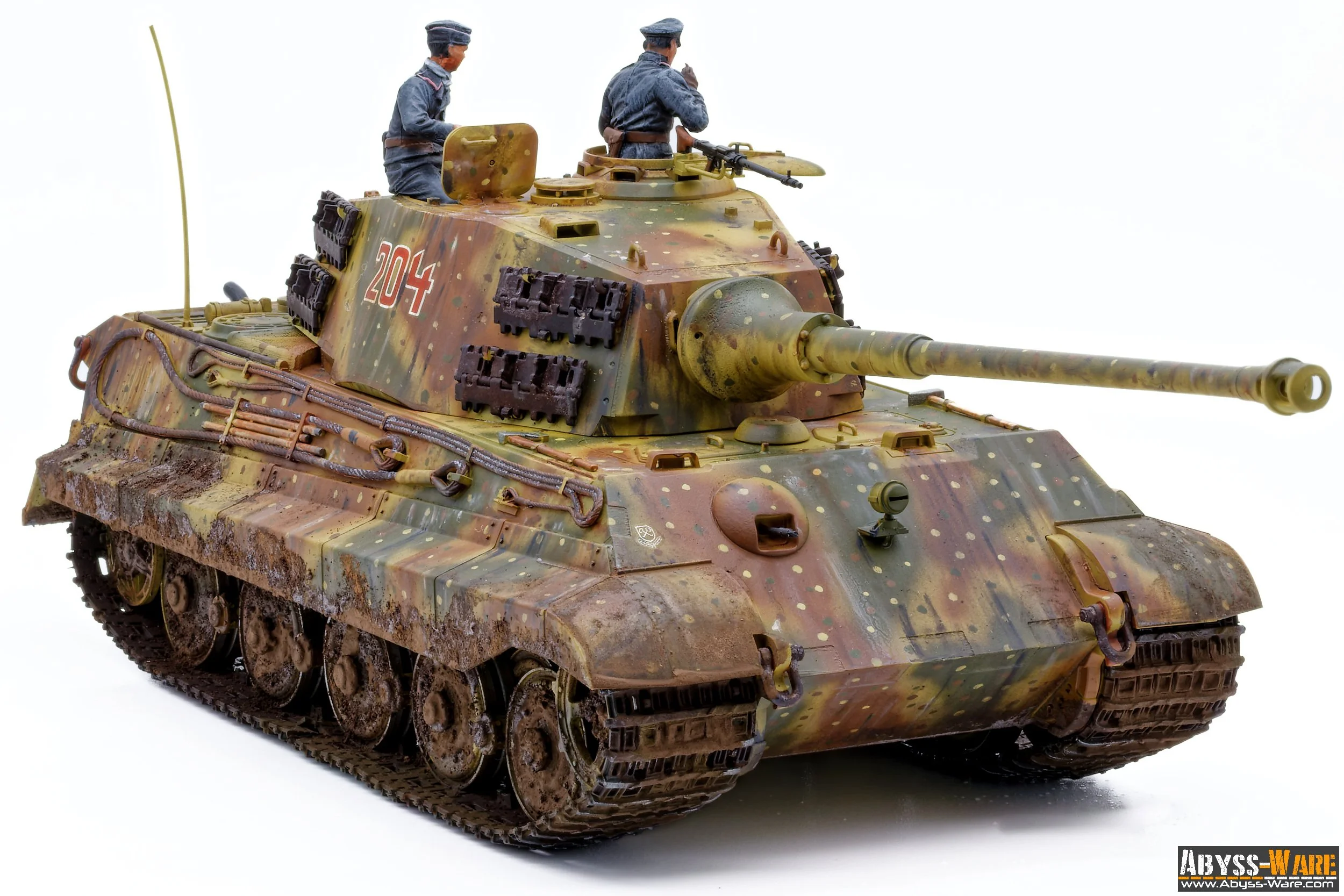
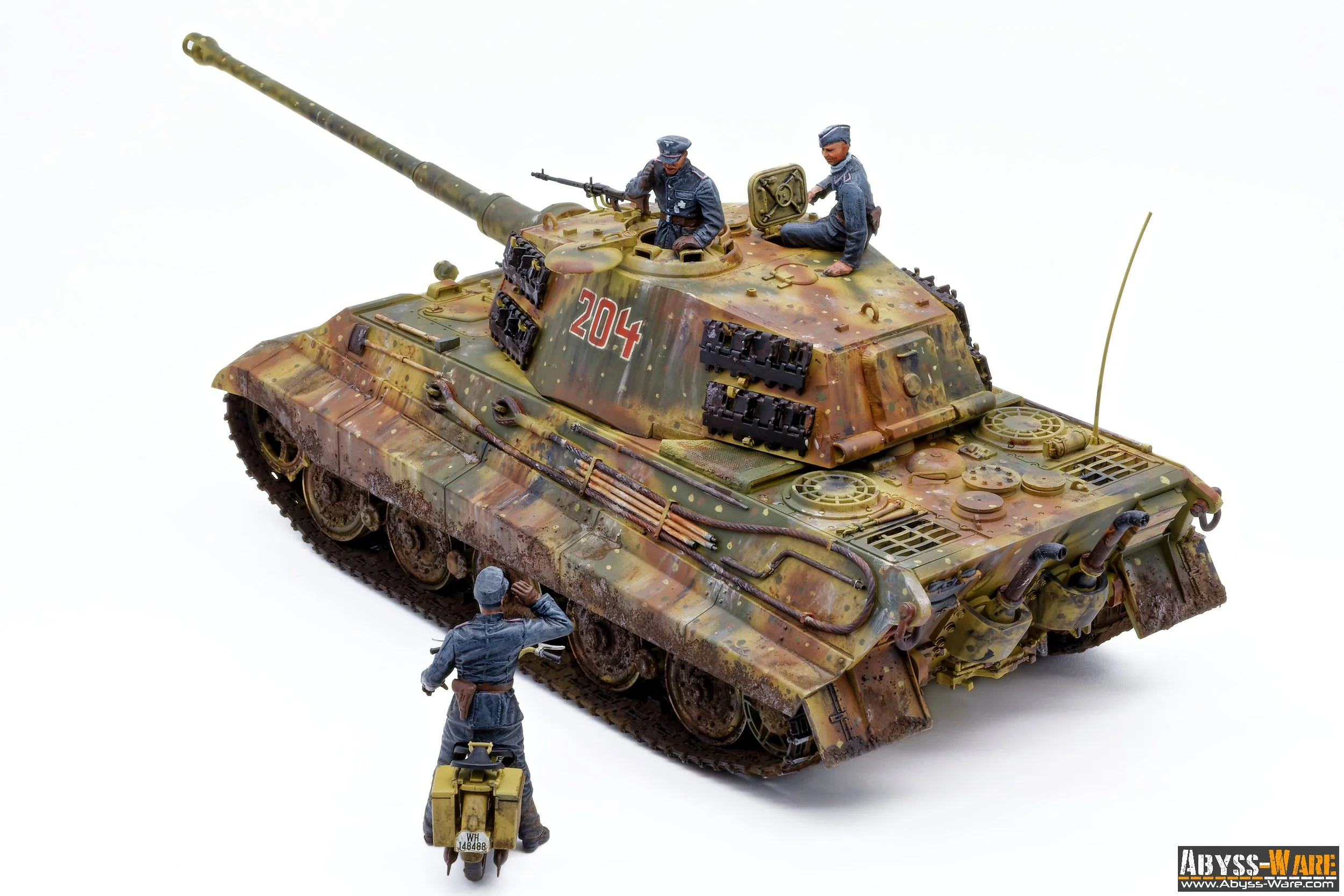
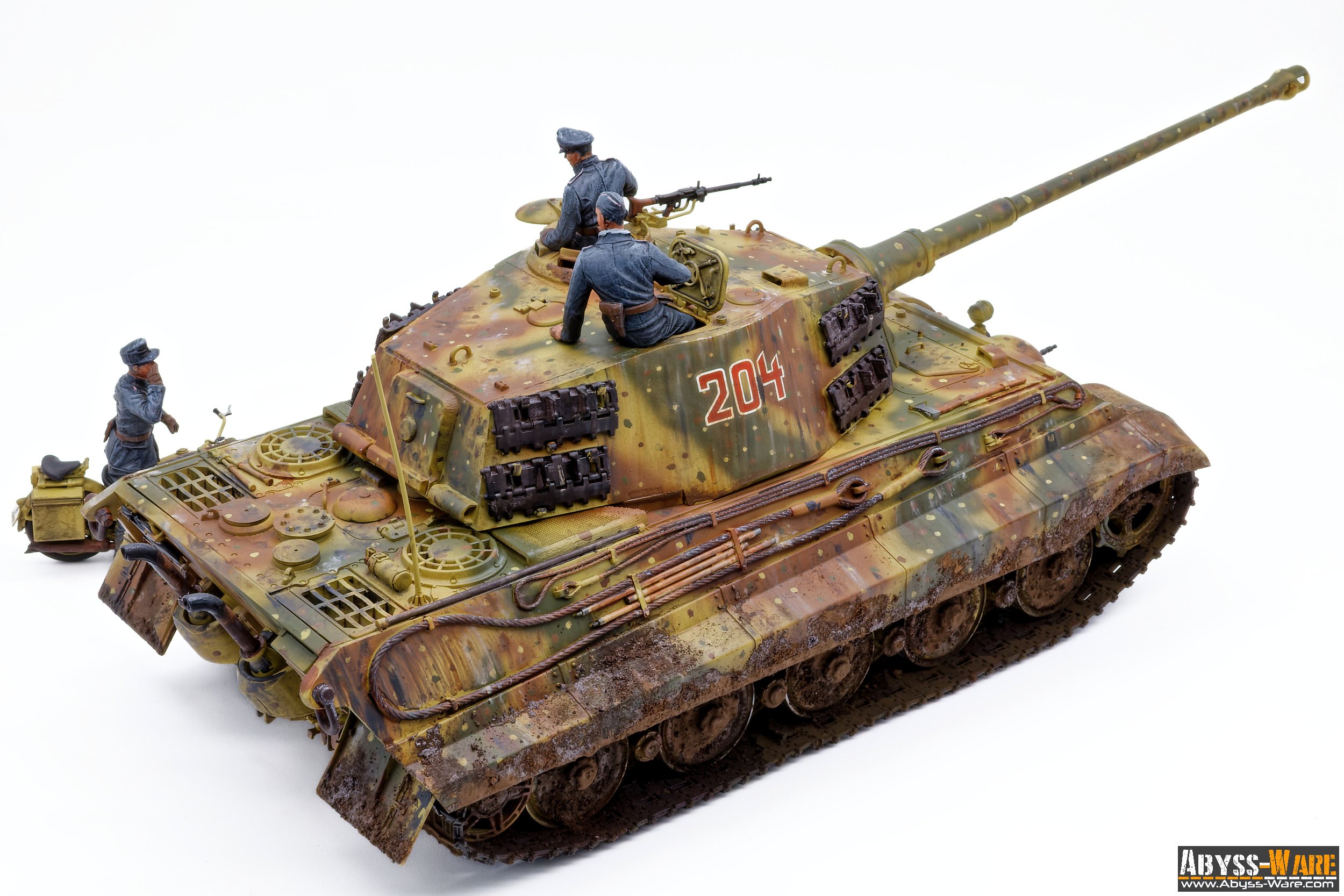
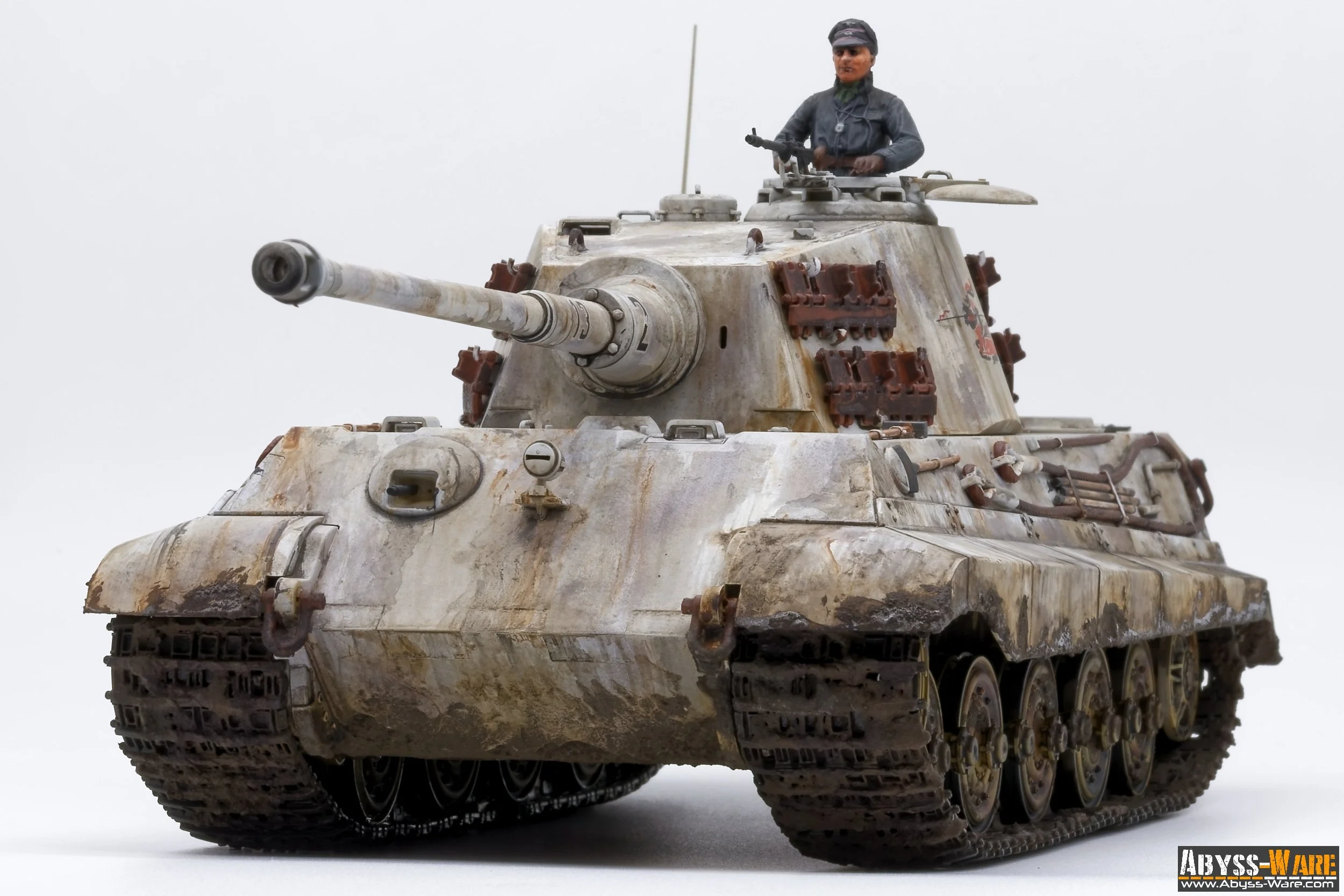
Note: The images presented bellow feature photographs of actual scale models, enhanced with AI-generated backgrounds and environments for visual effect. These visuals are intended for illustrative and artistic purposes only and should not be interpreted as real photographs or historical references.
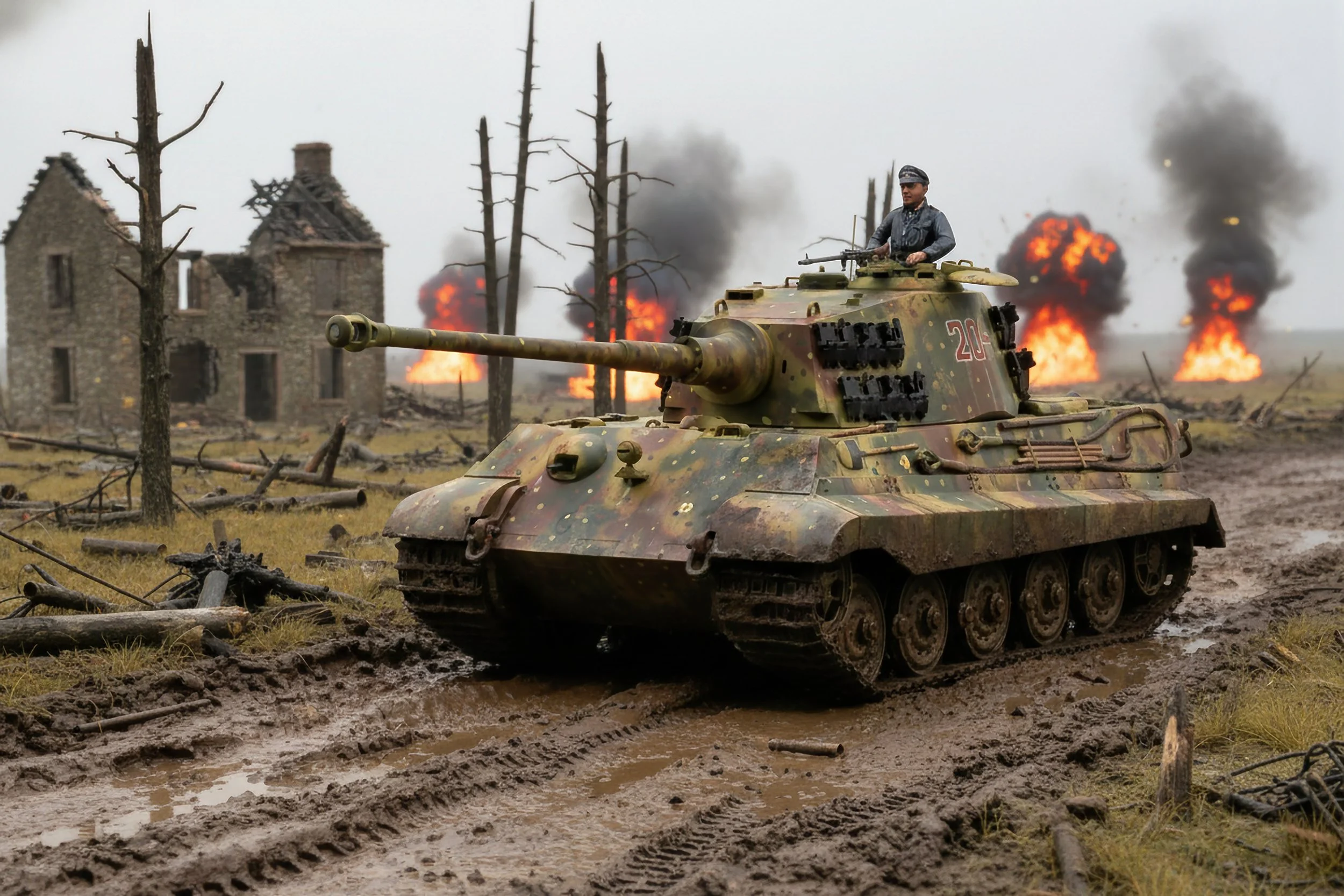
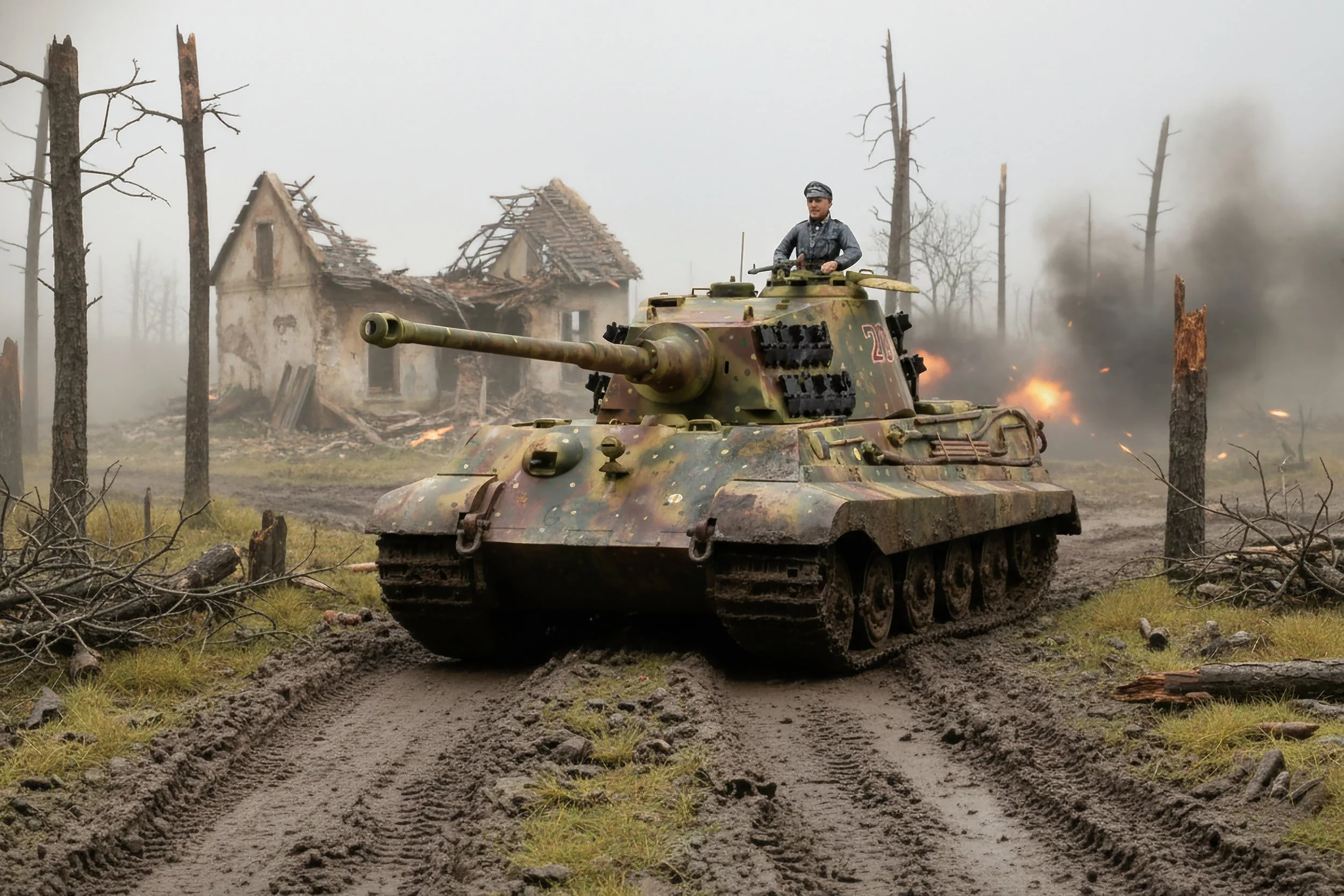
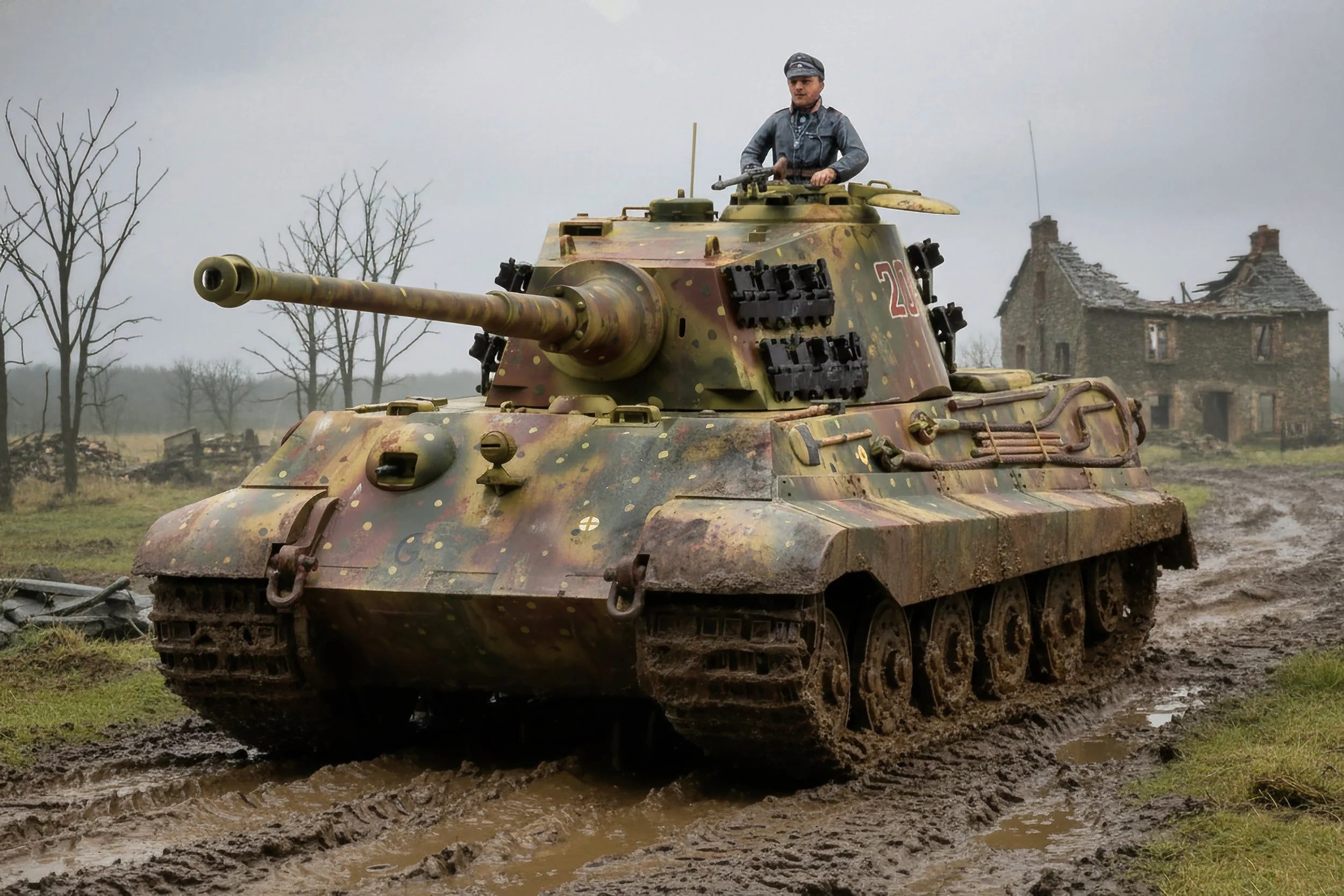
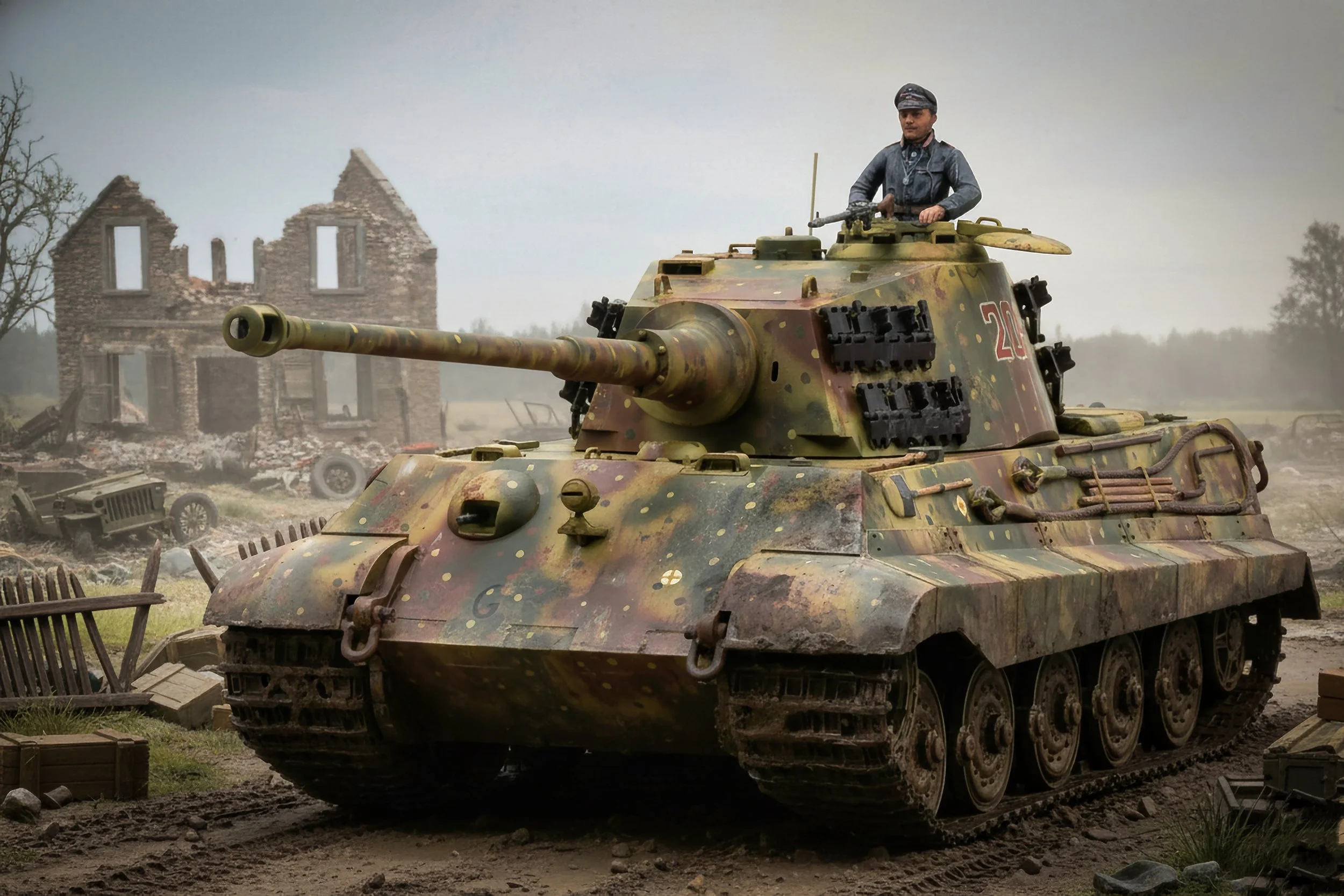
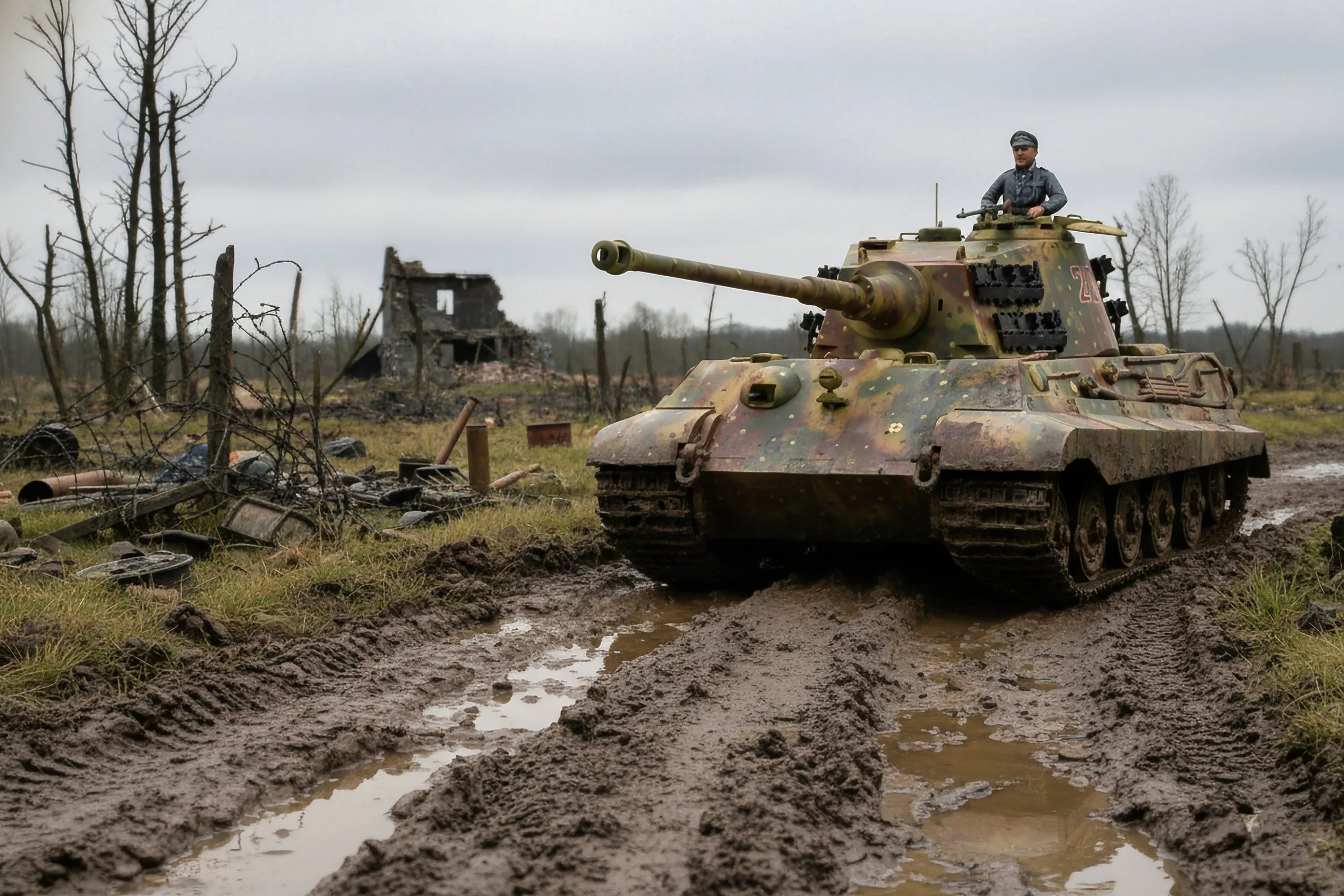
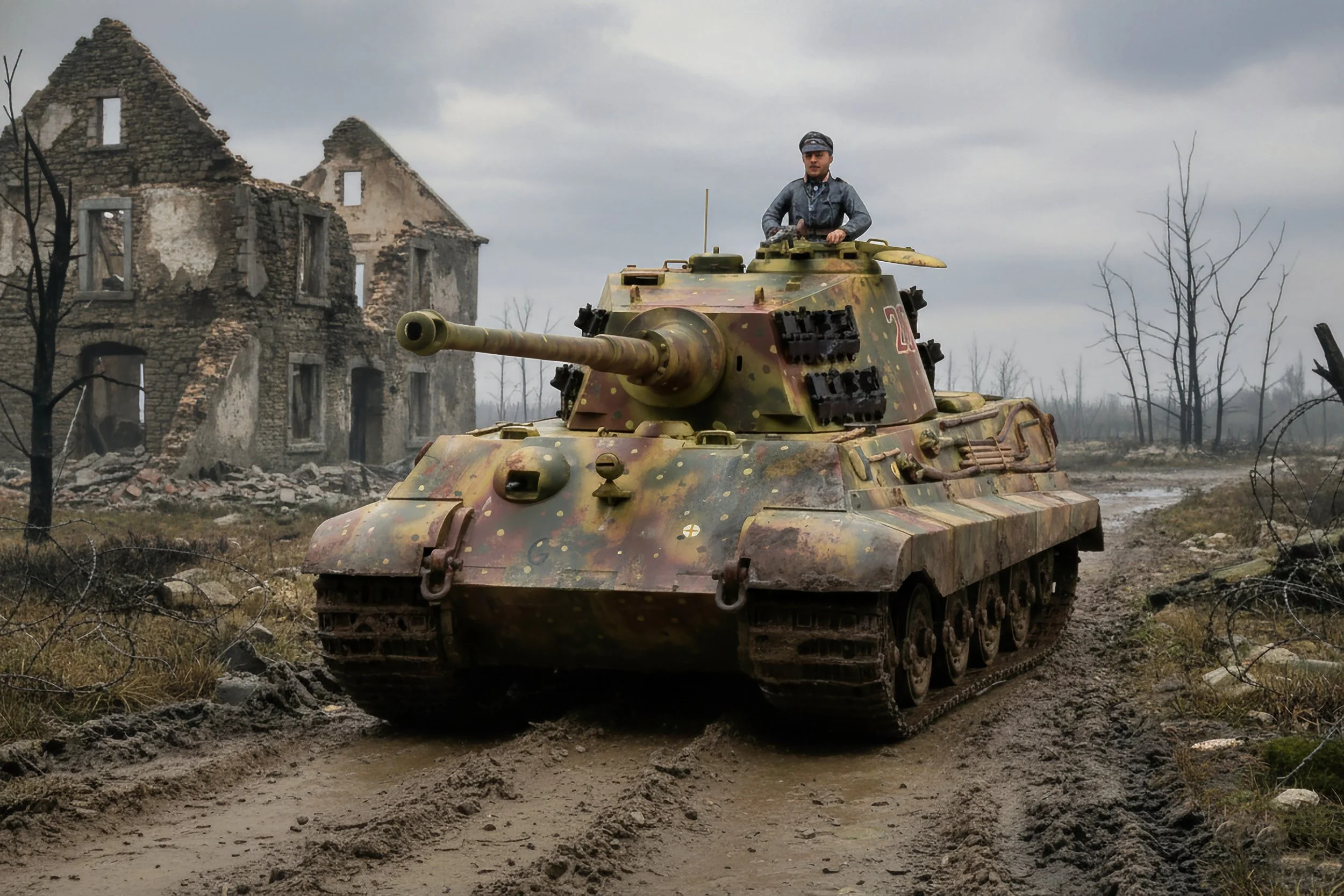
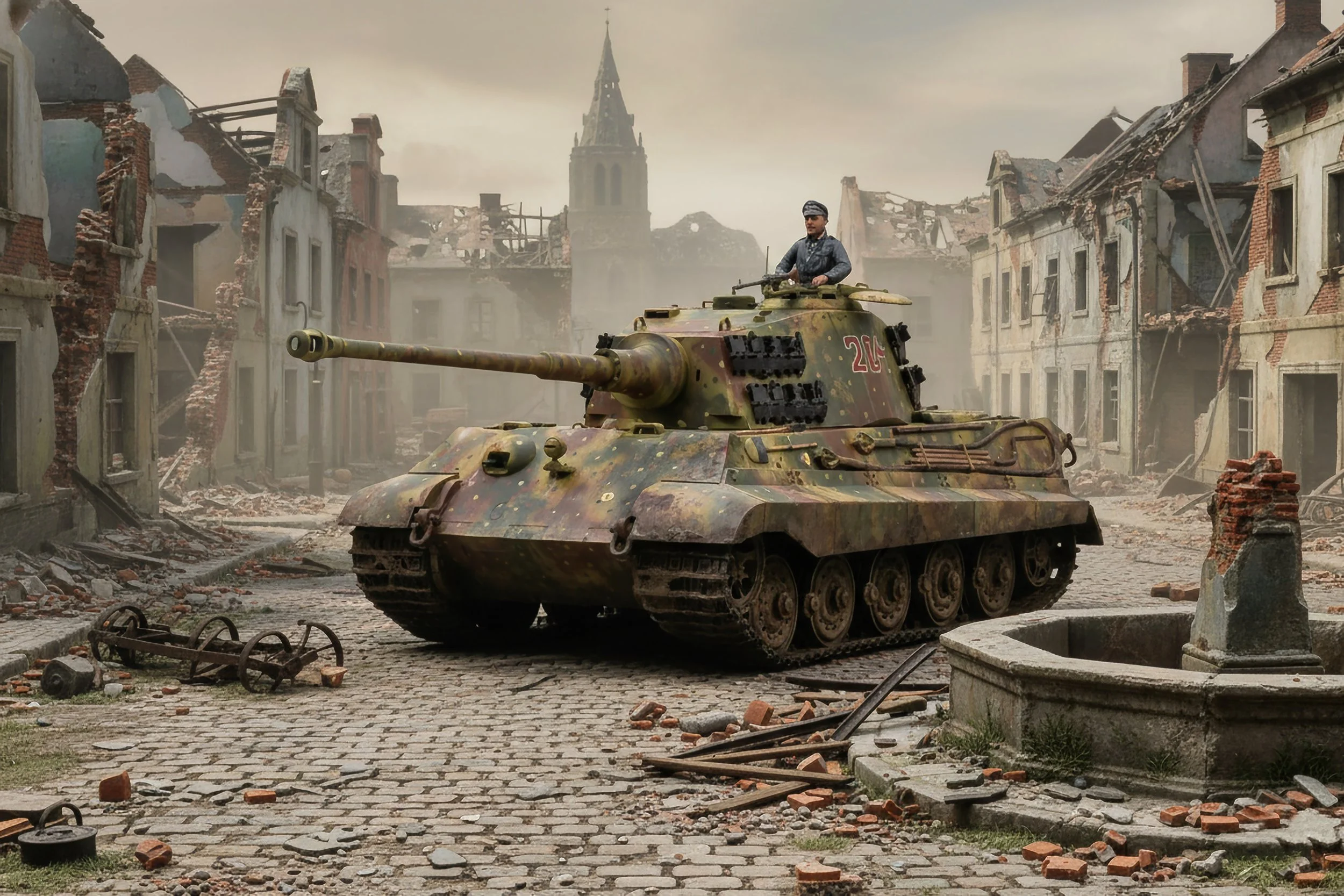
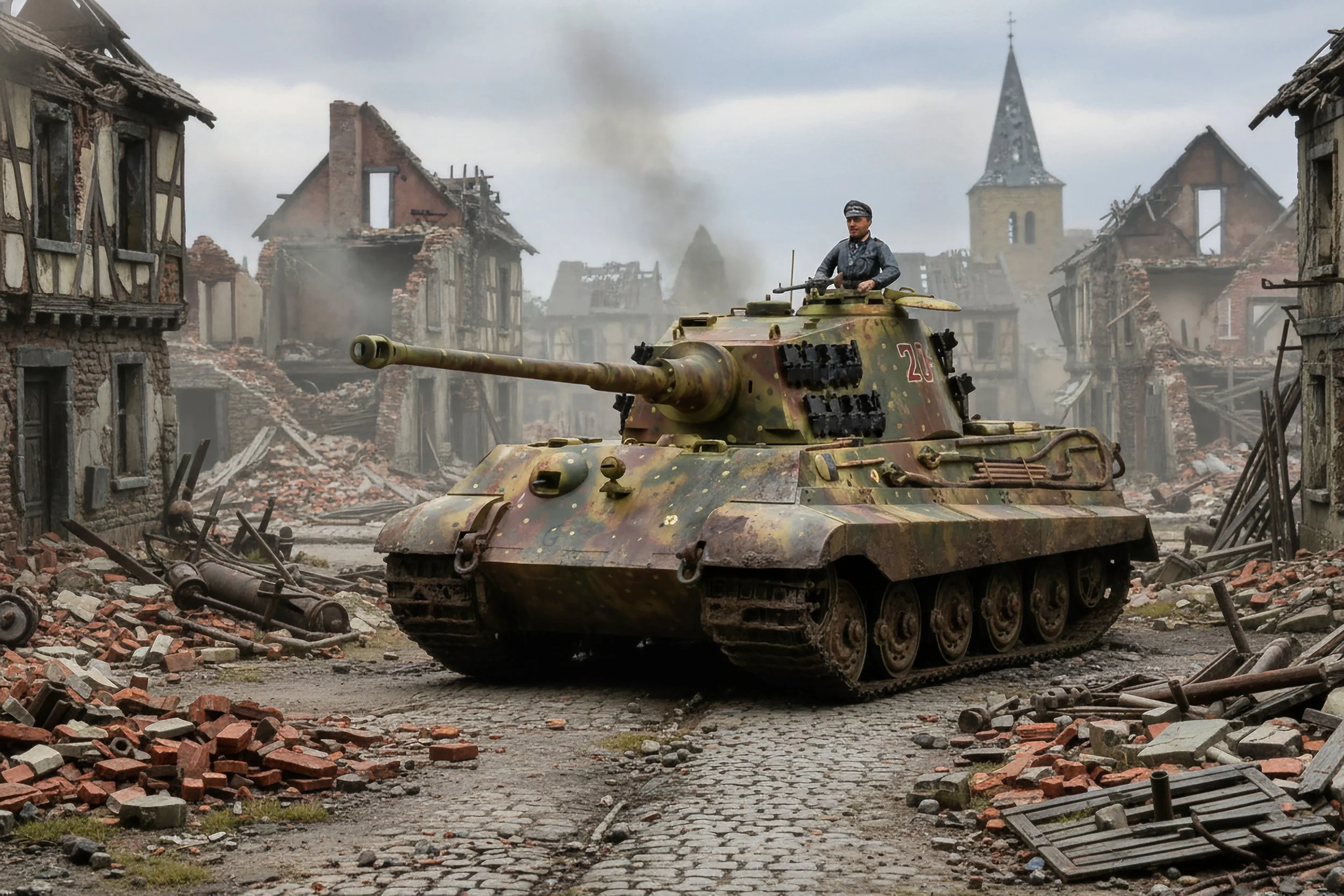
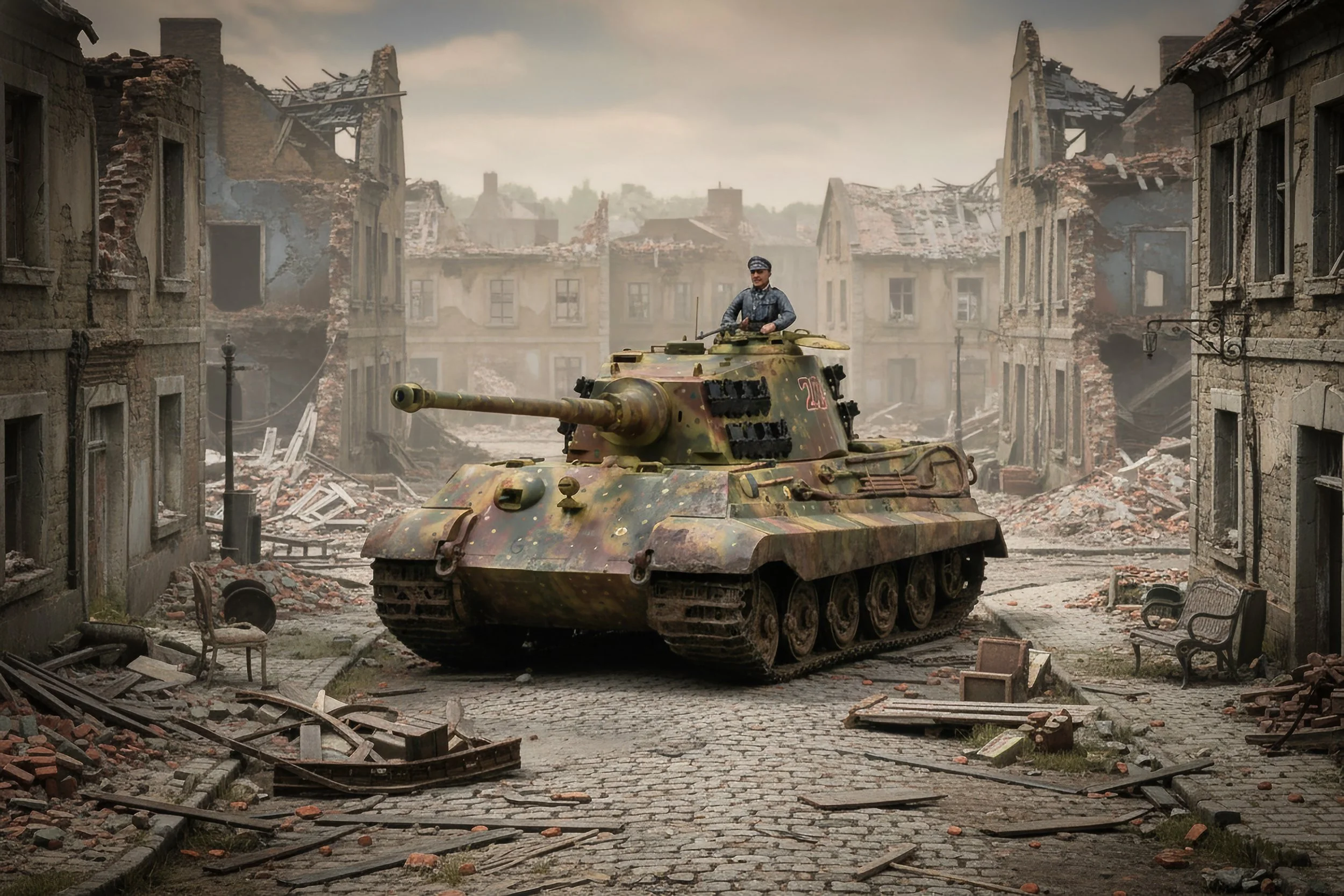
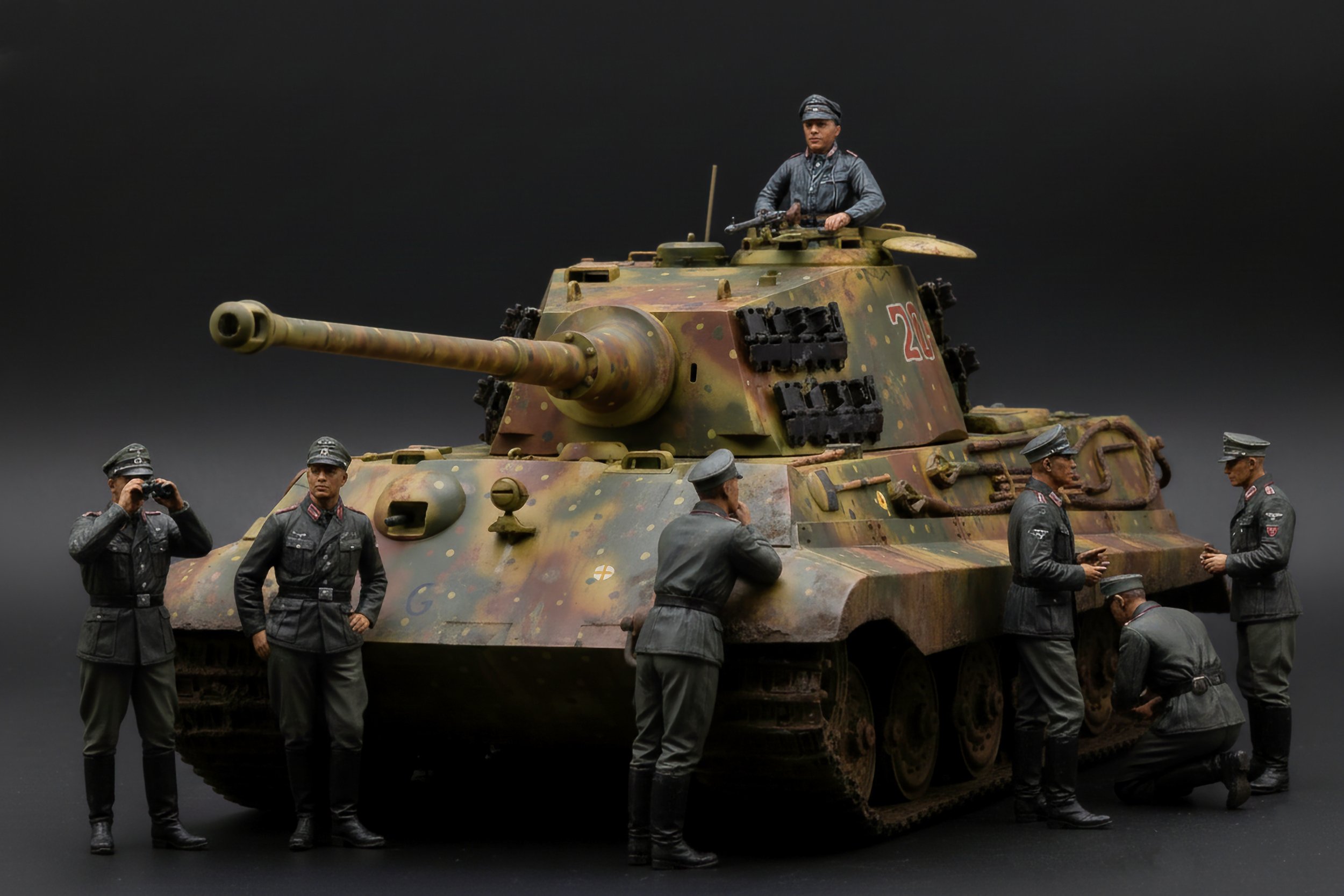
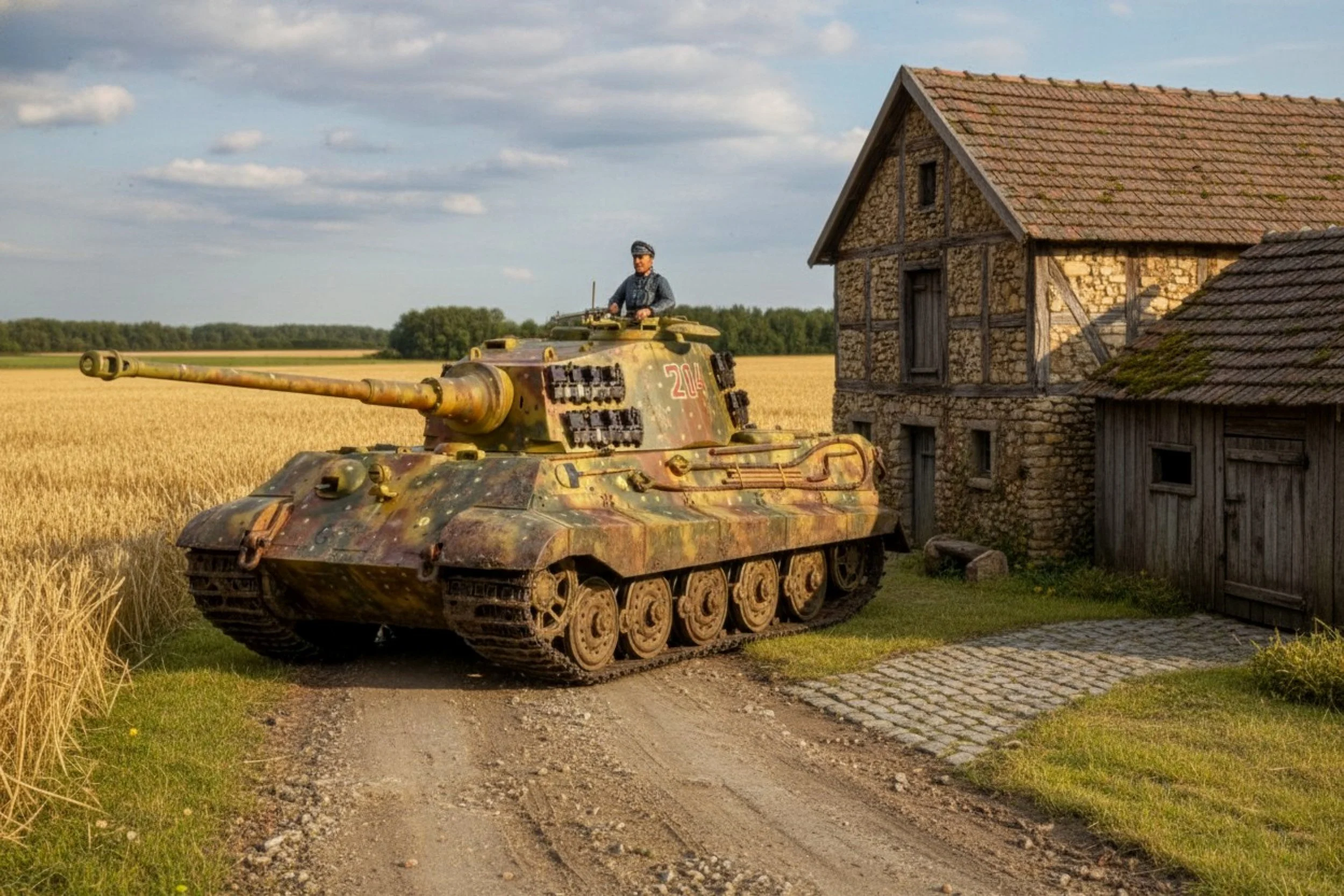
A build of another version of the kit - different figures and a motorcycle added;
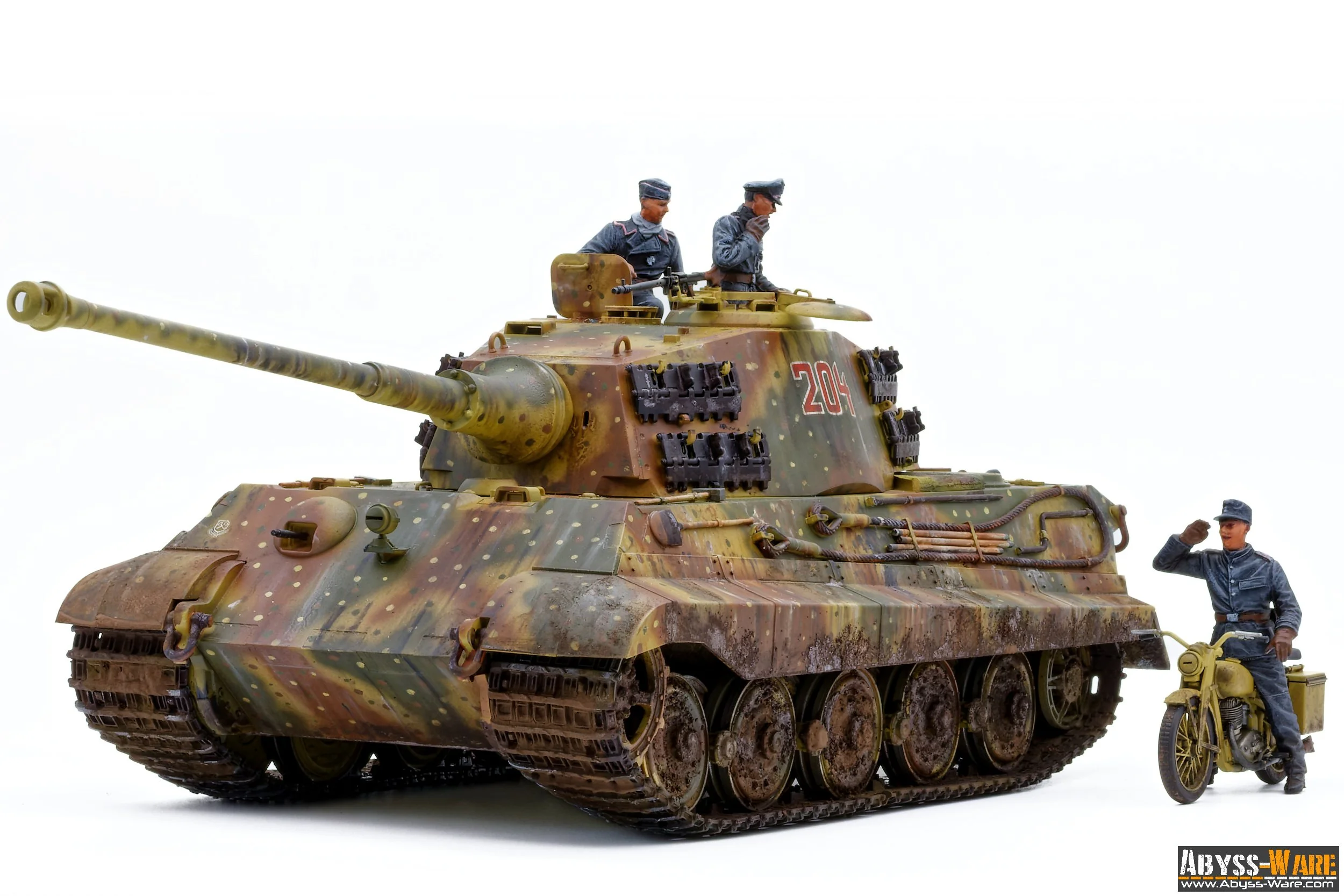
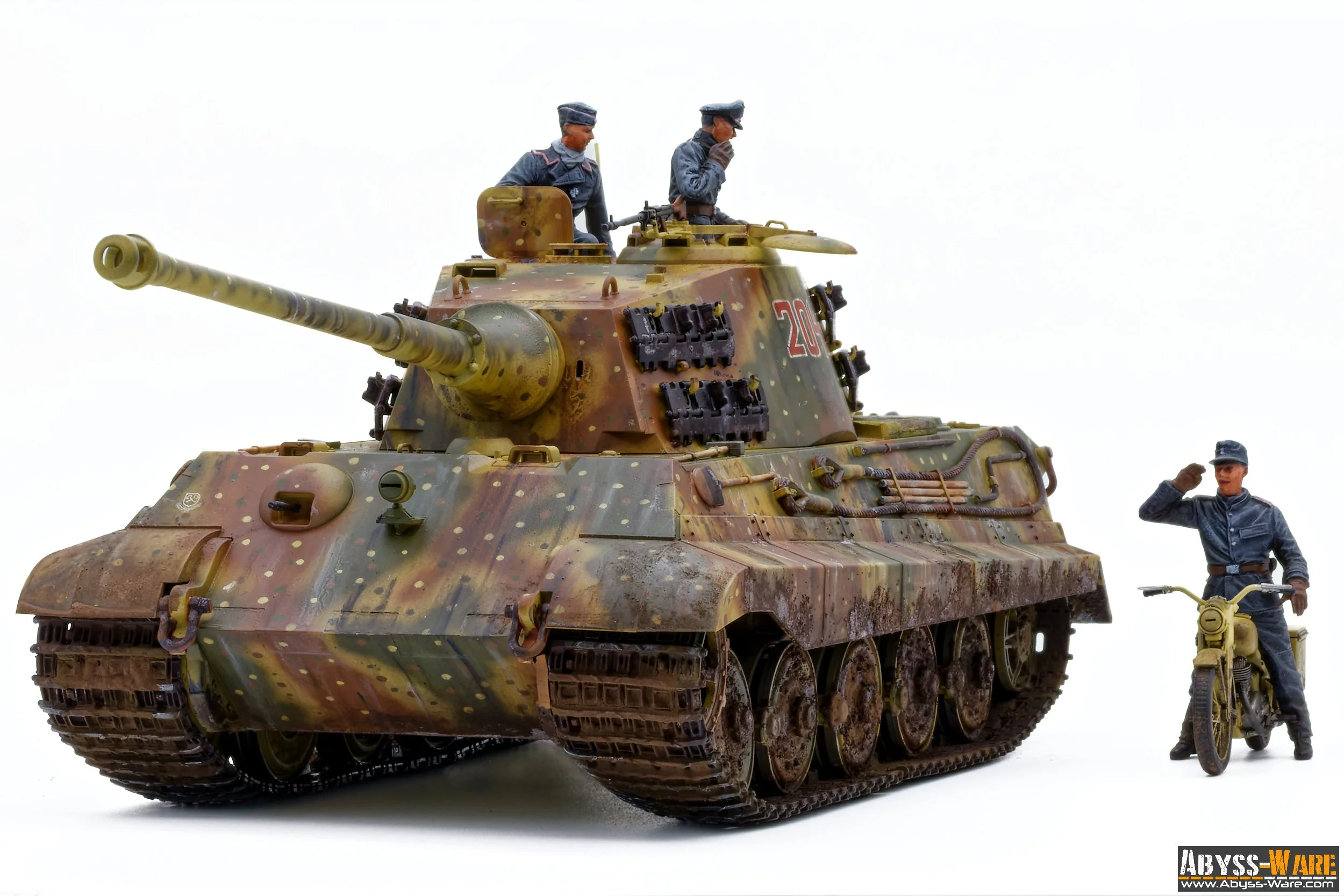
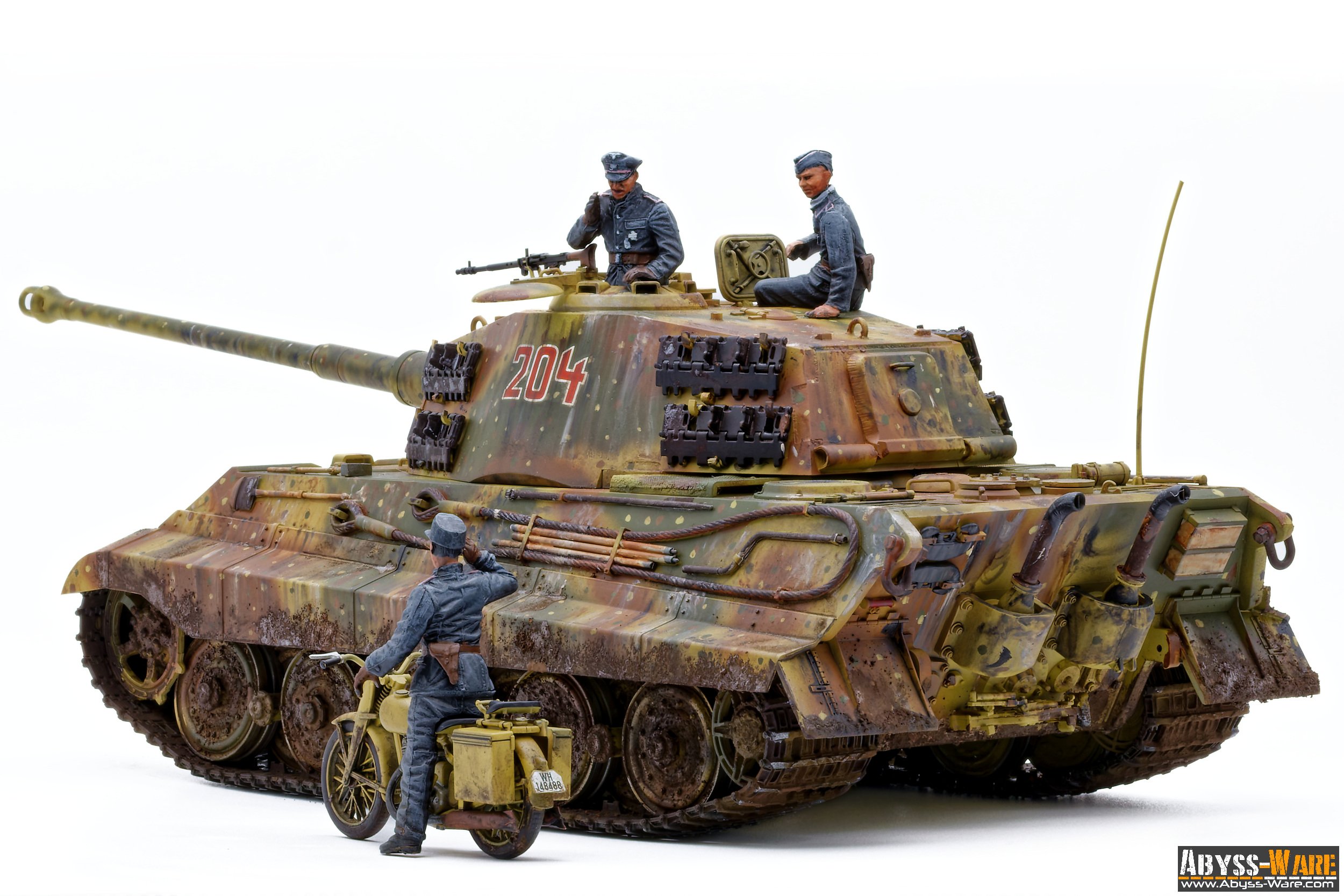
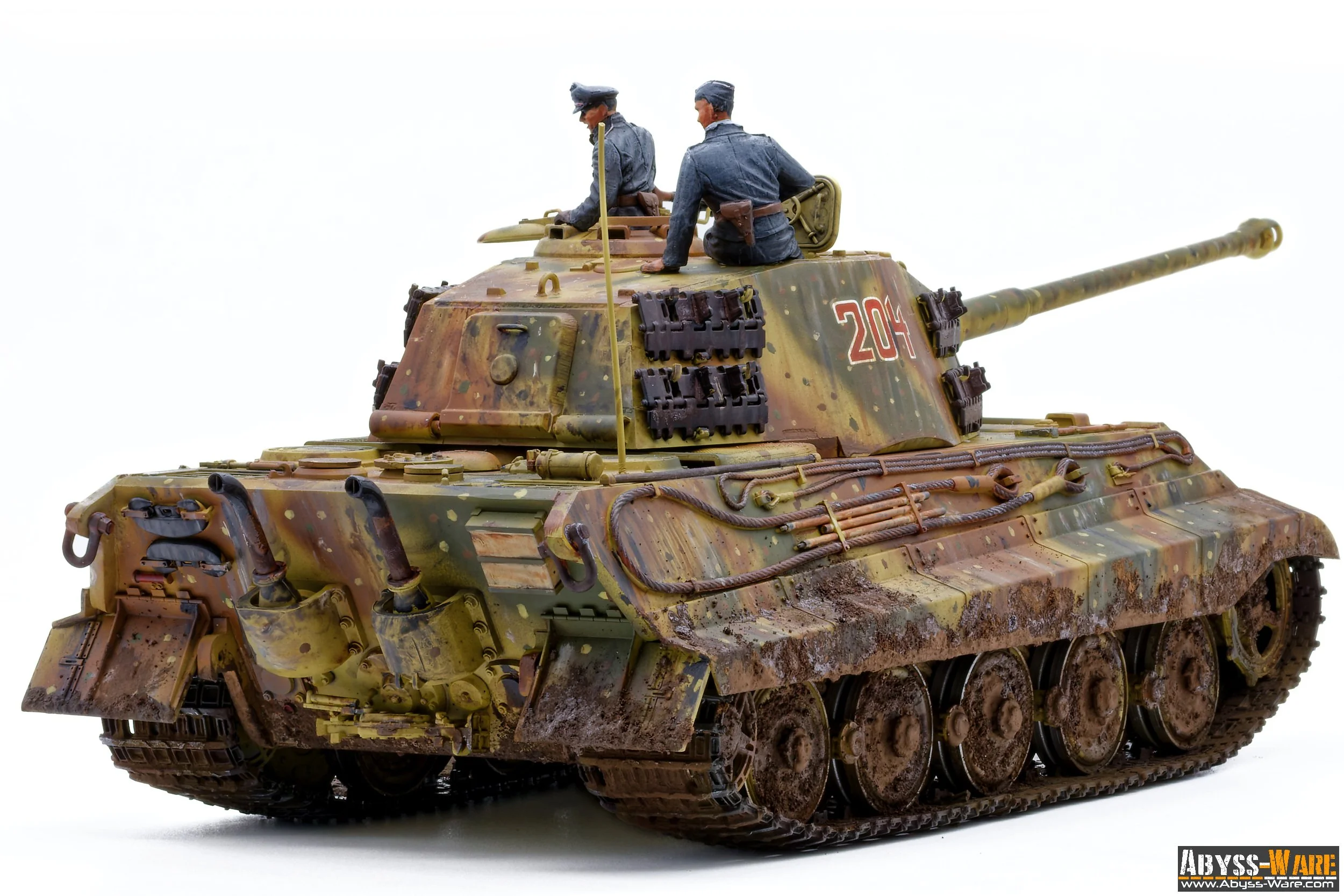
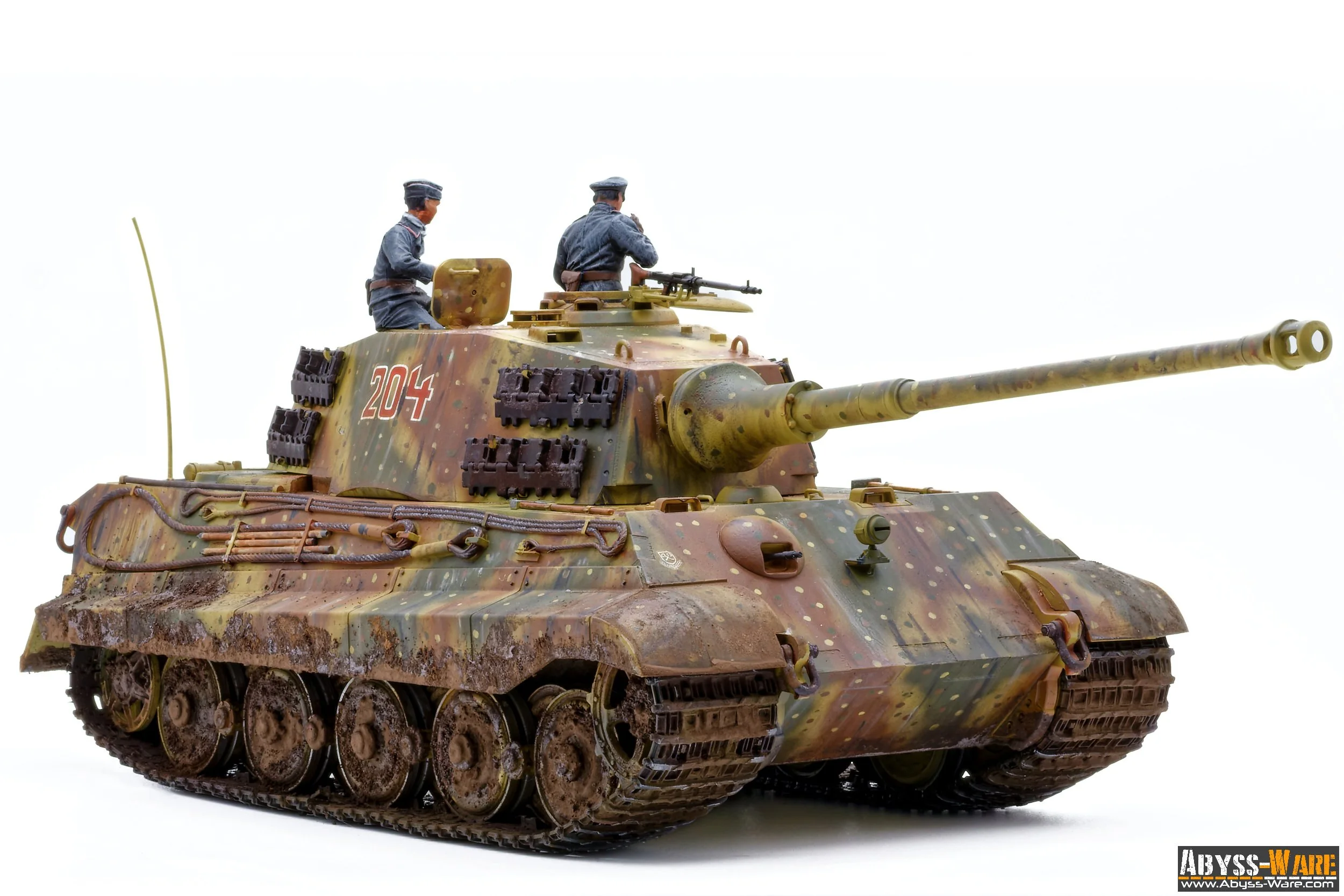
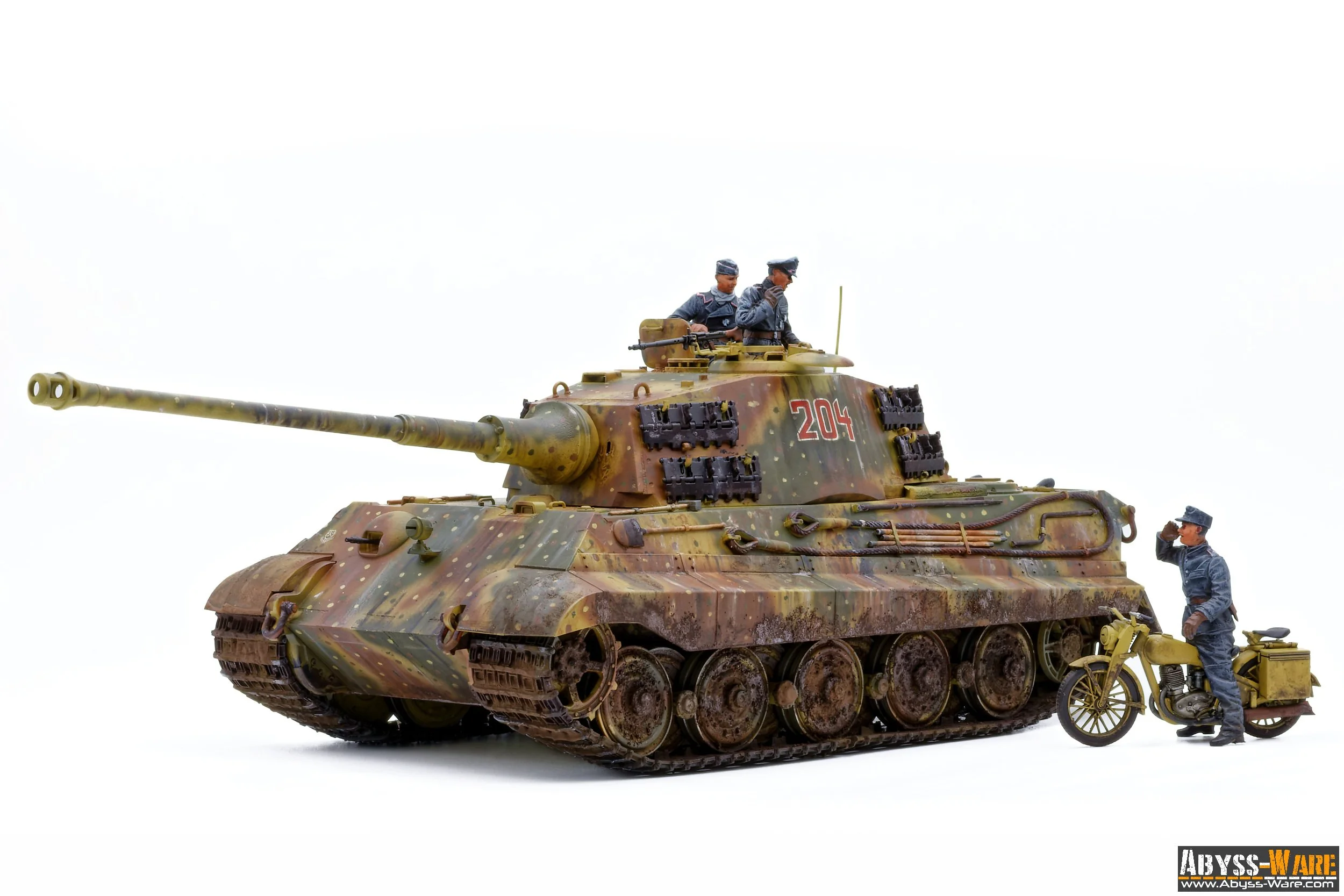
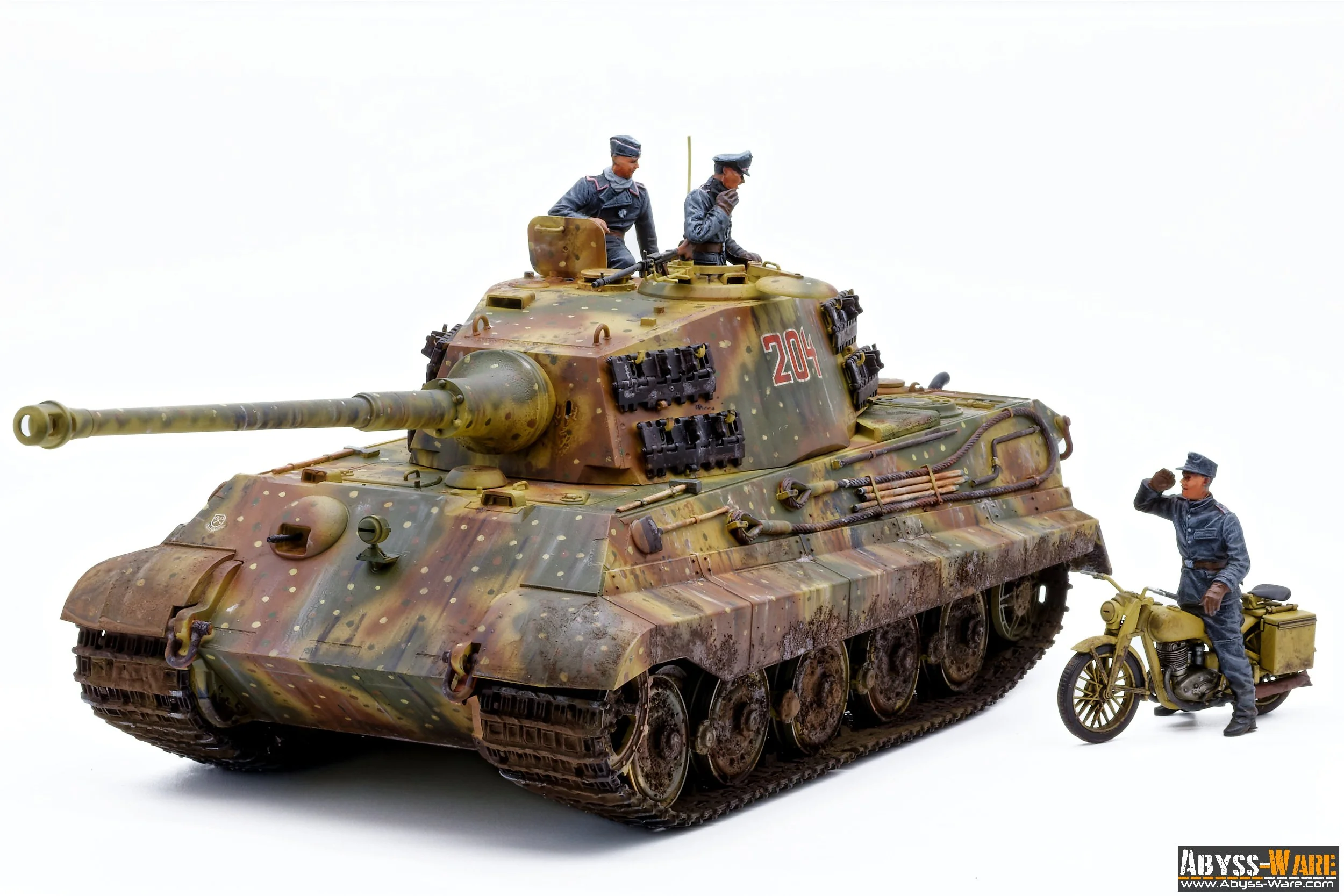
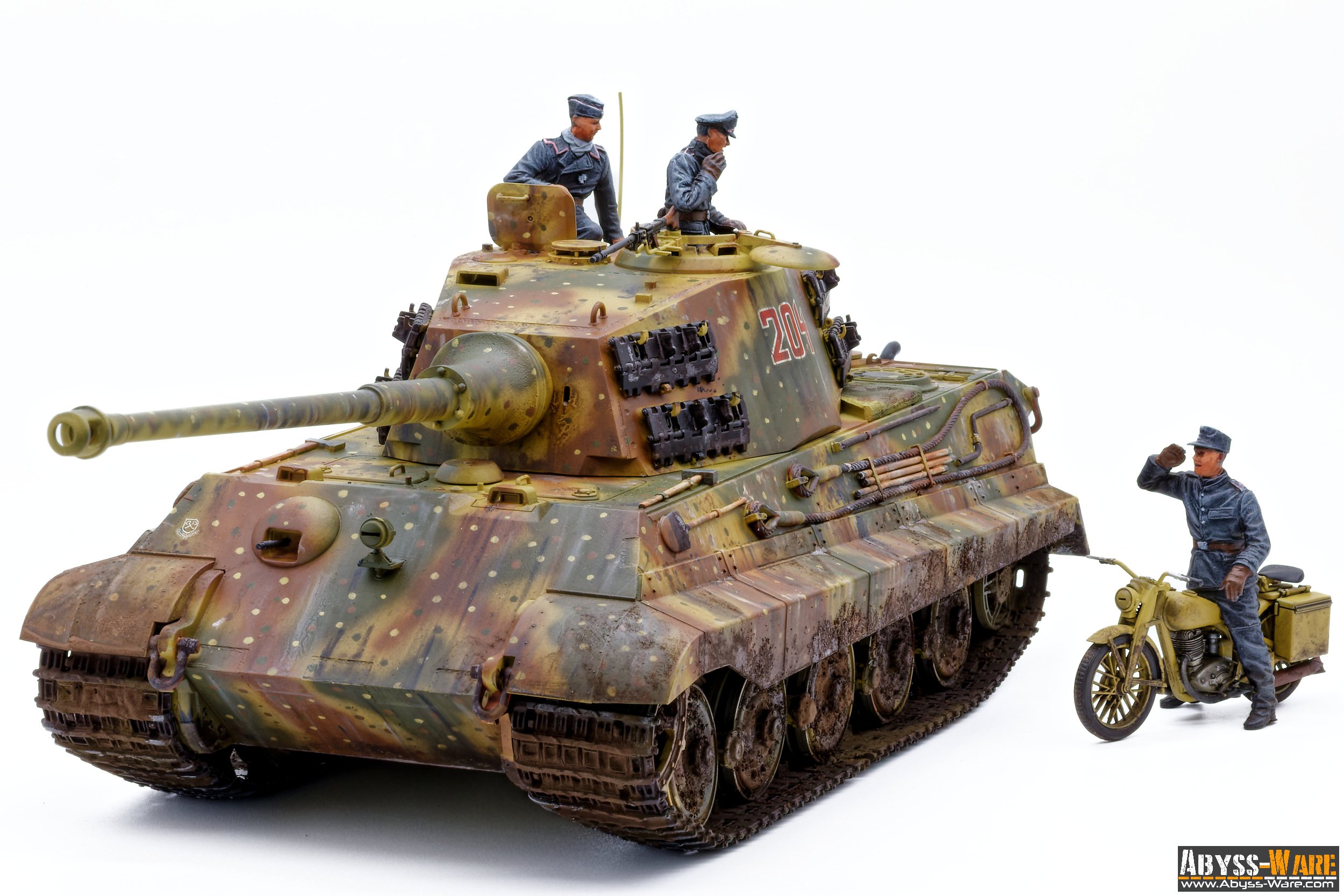
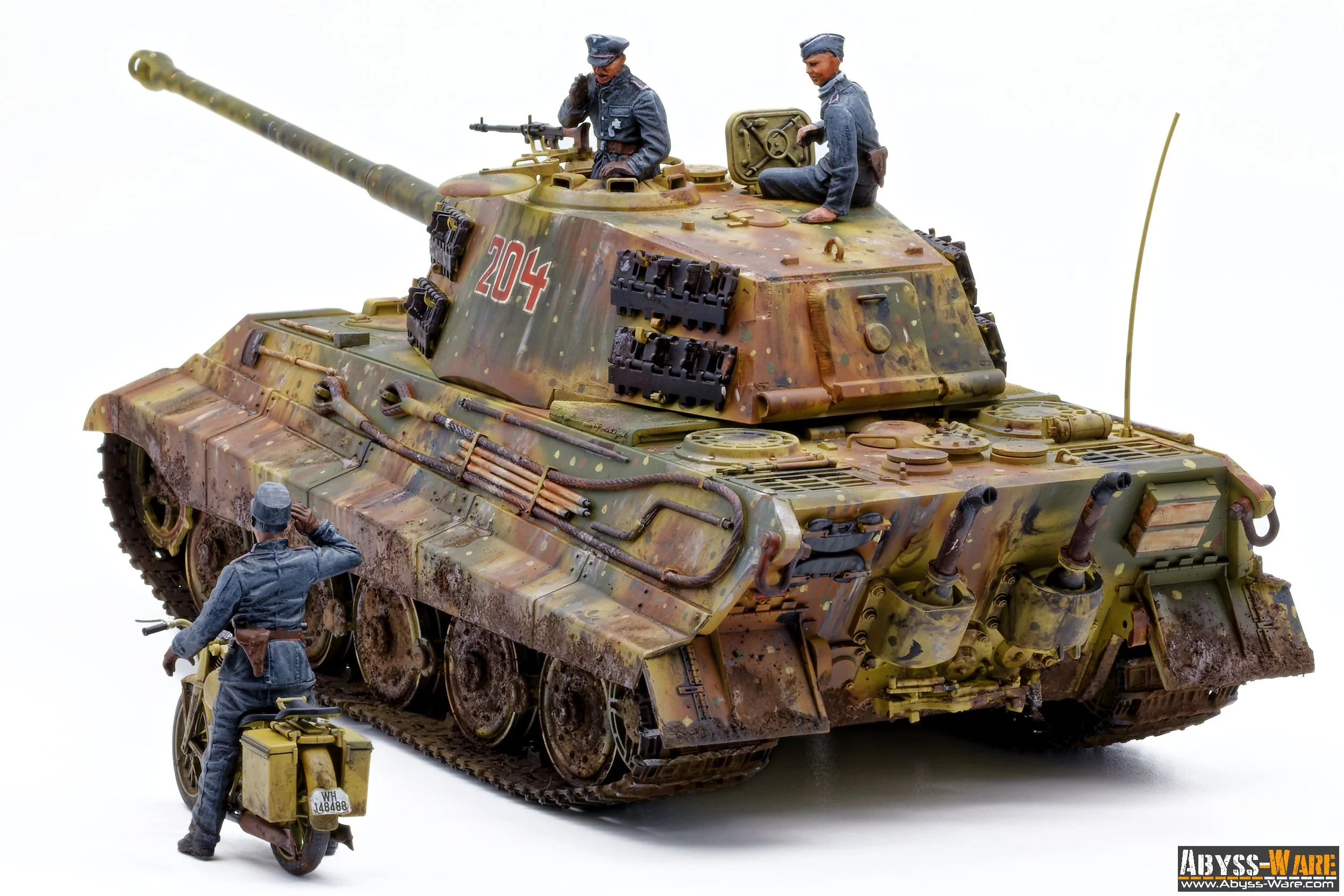
Winter camo version of the same kit
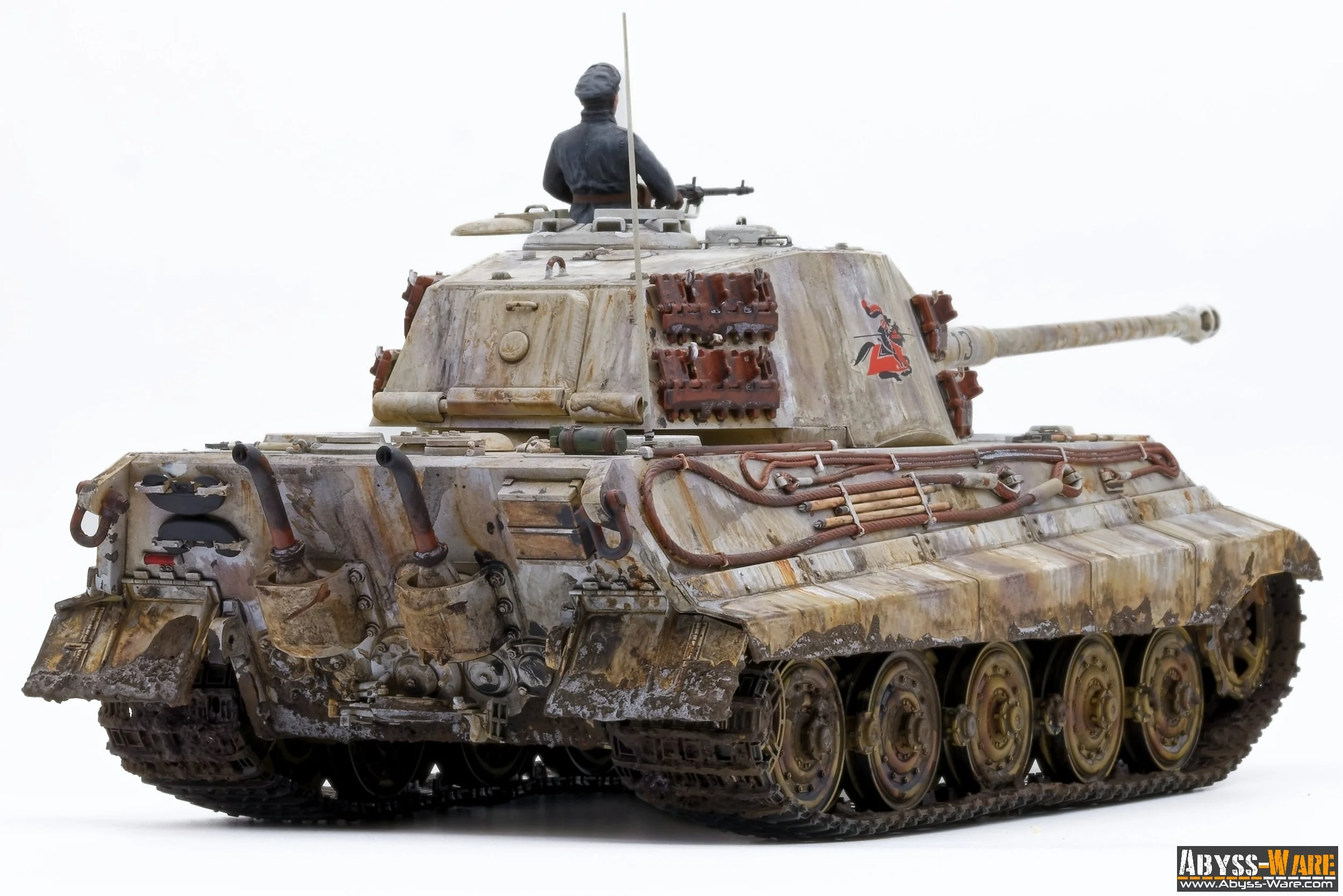
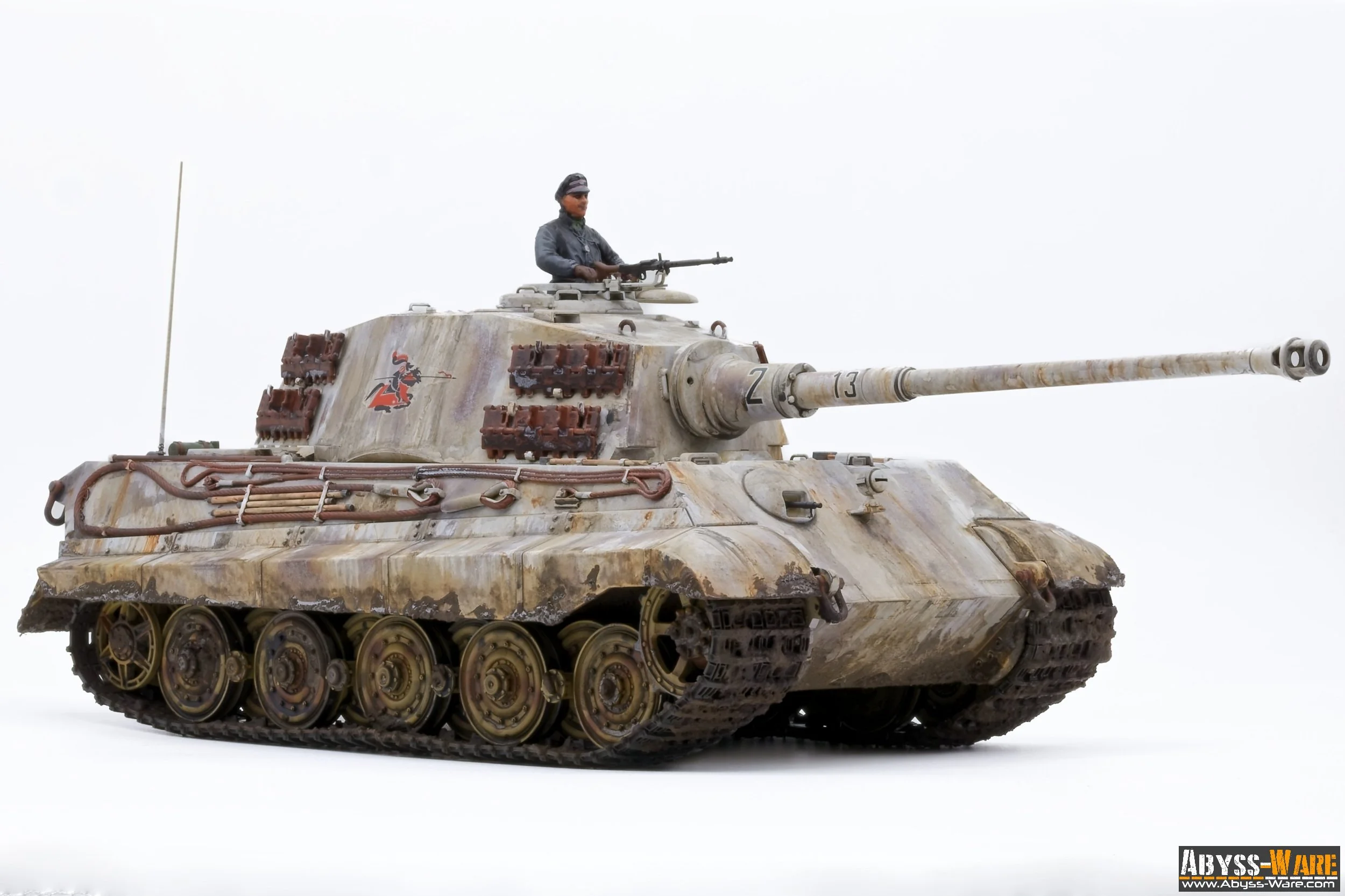
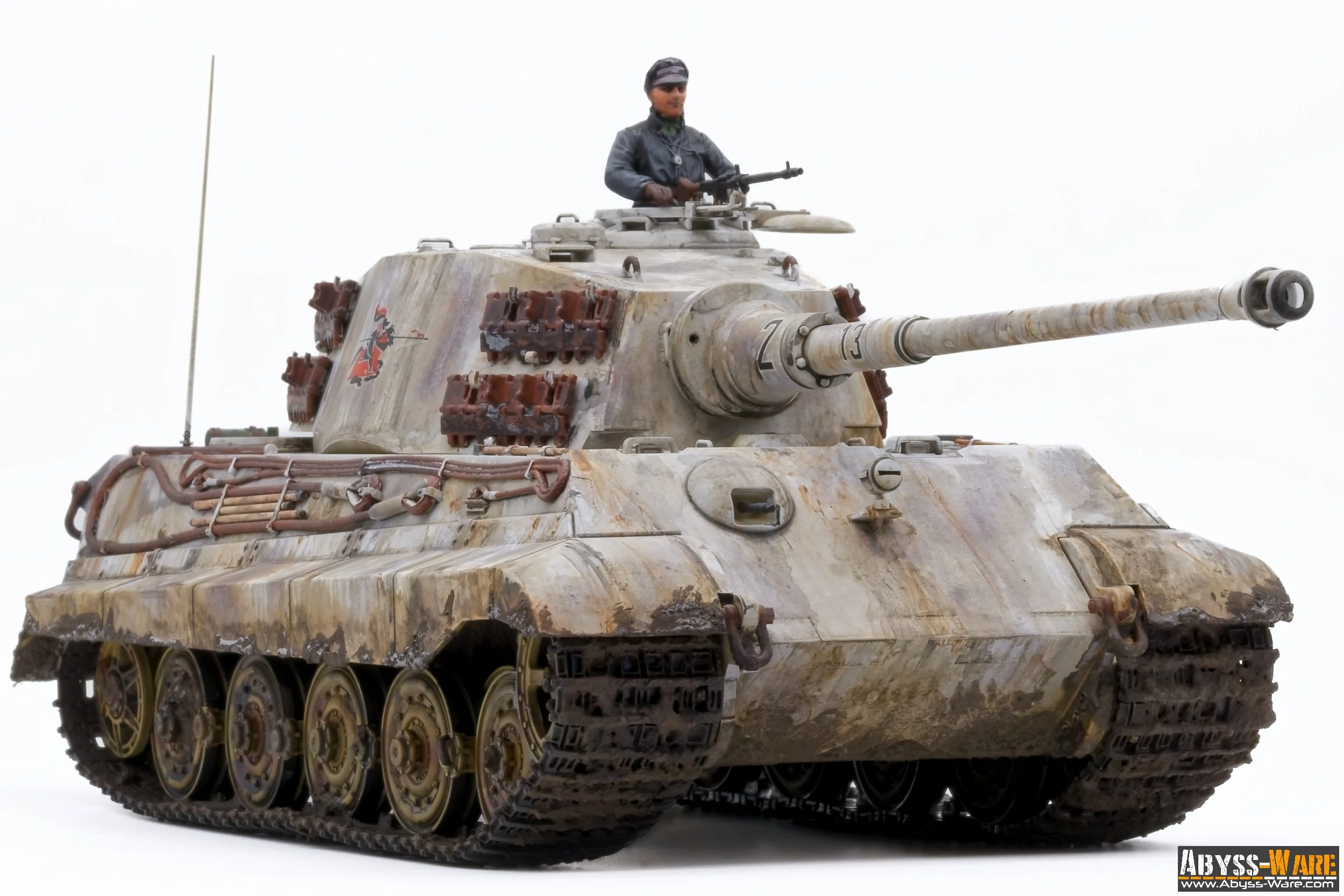
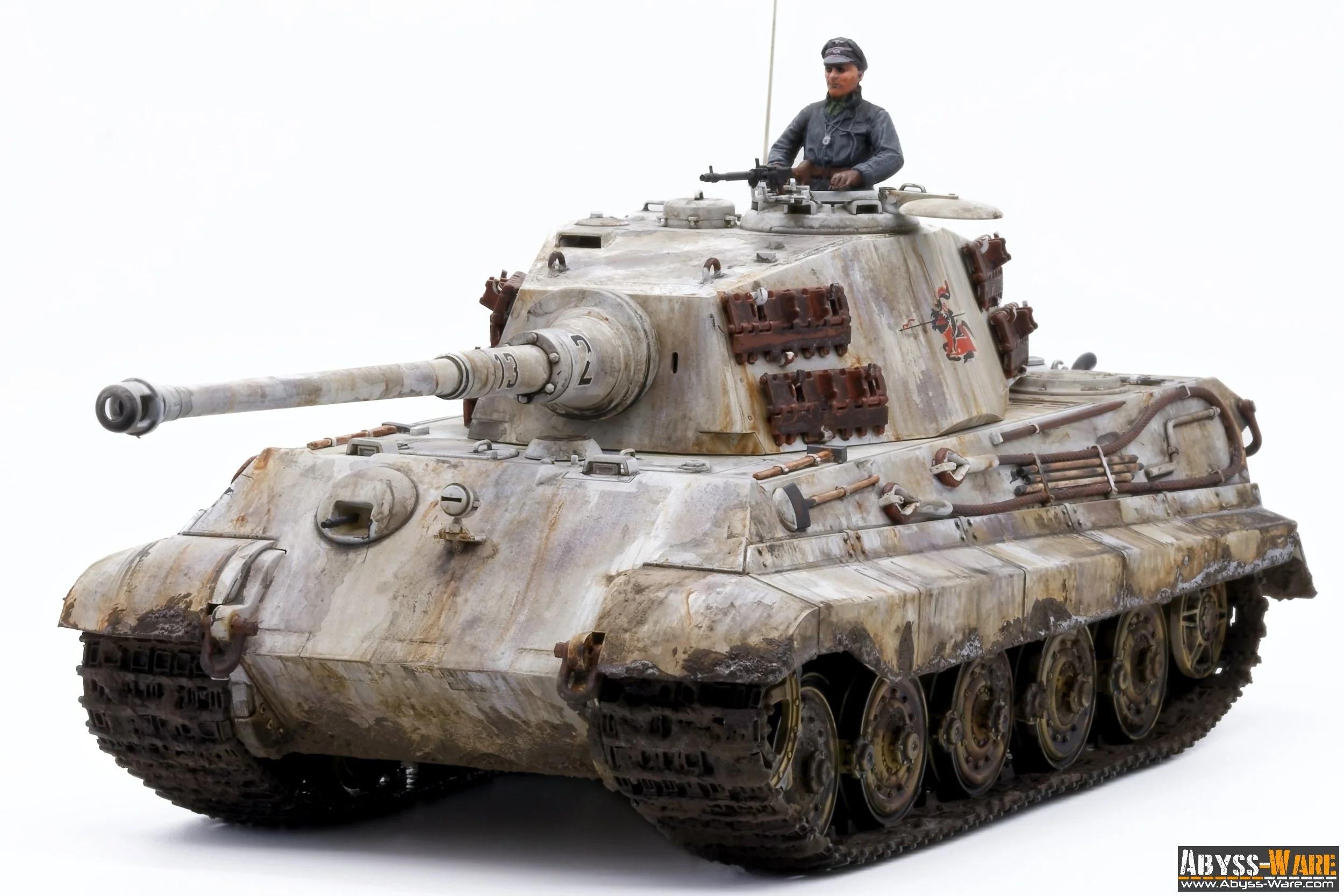
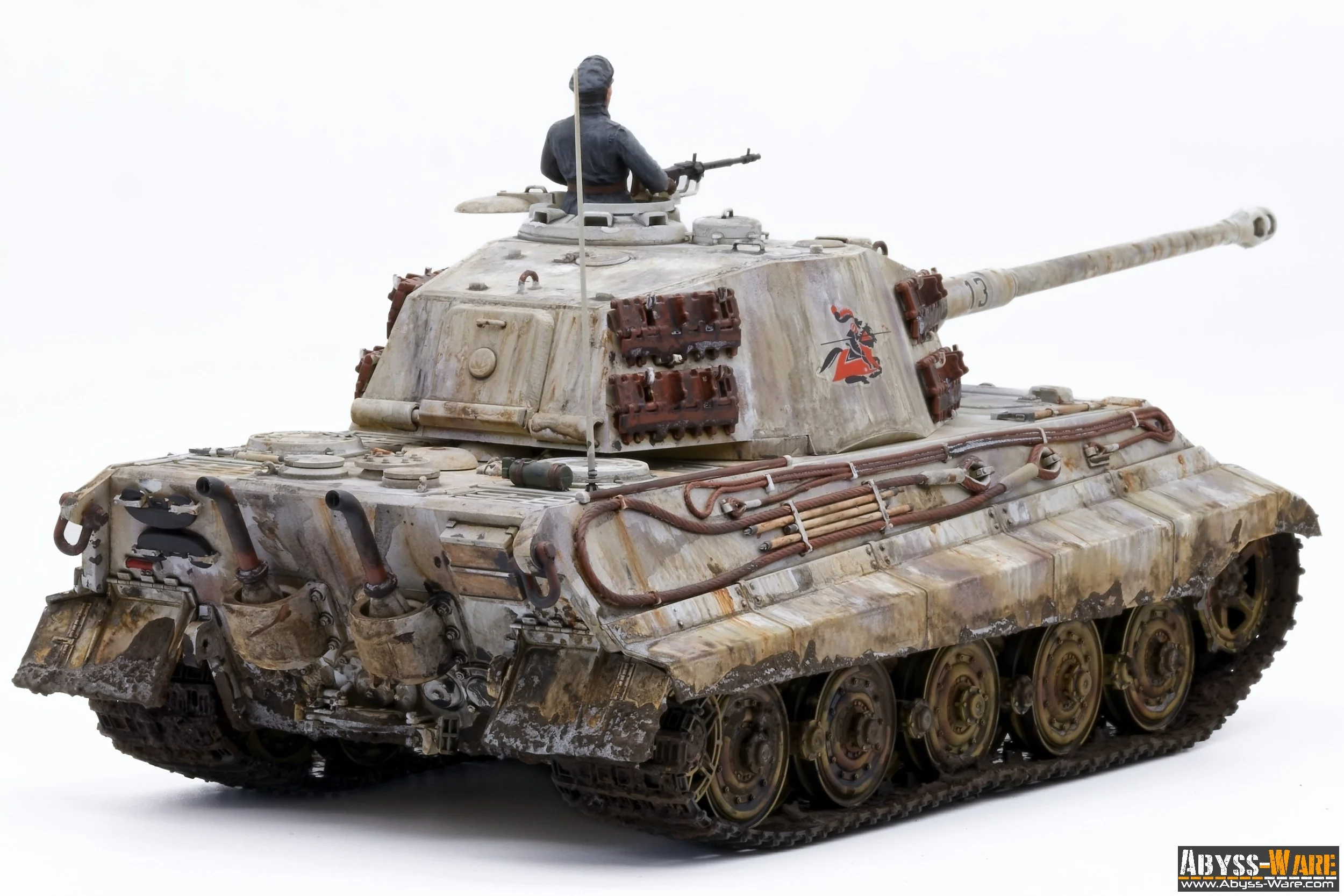
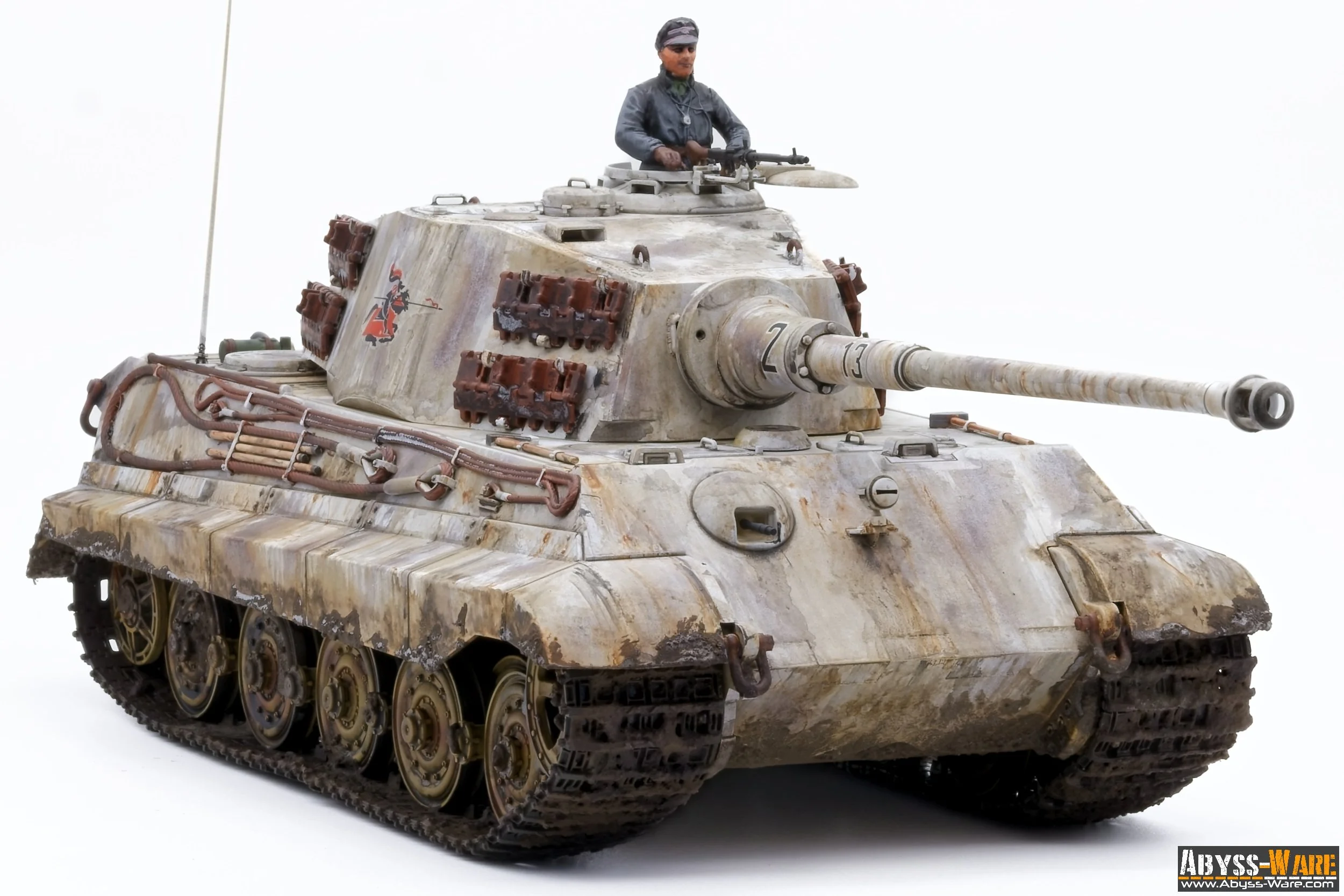
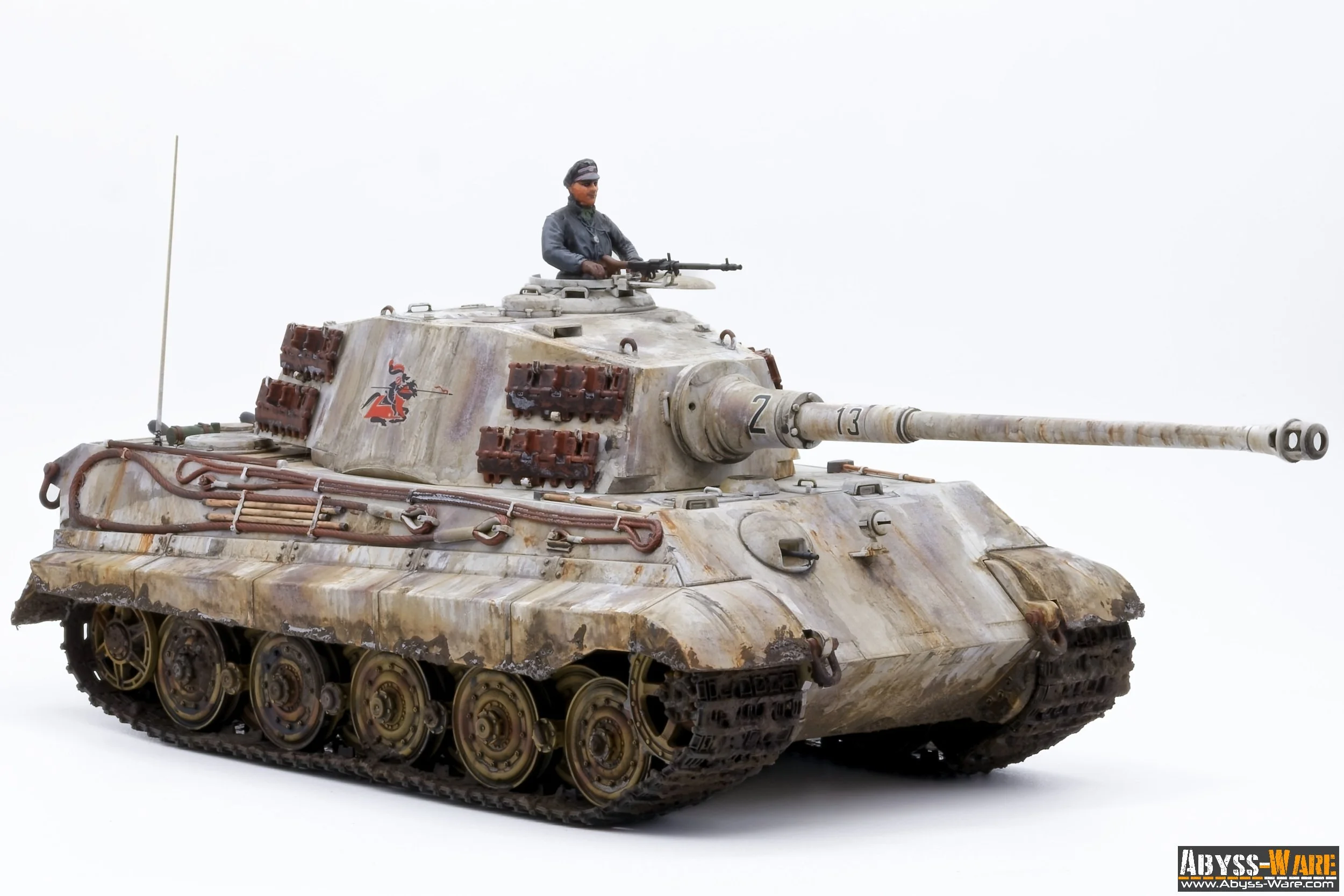
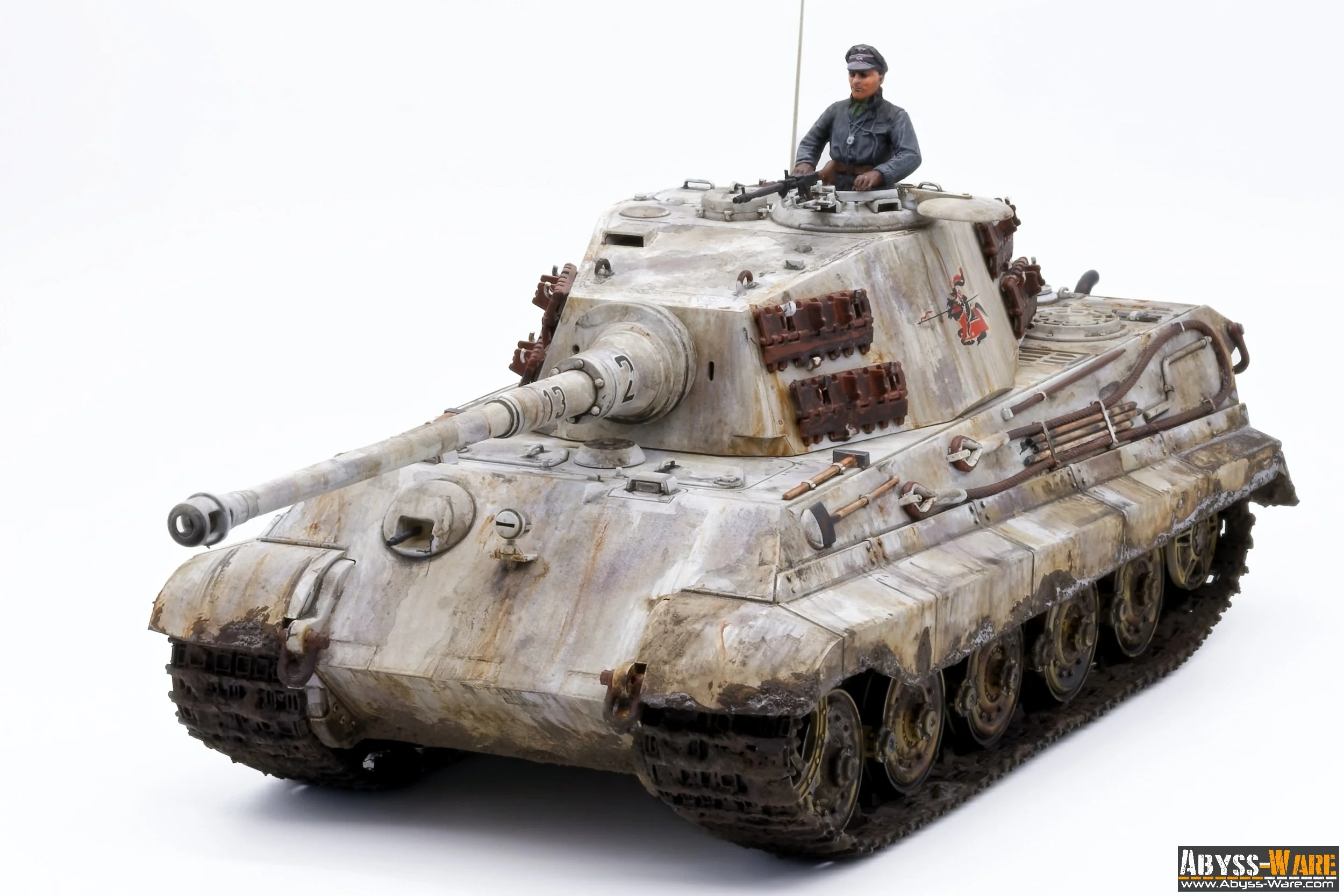
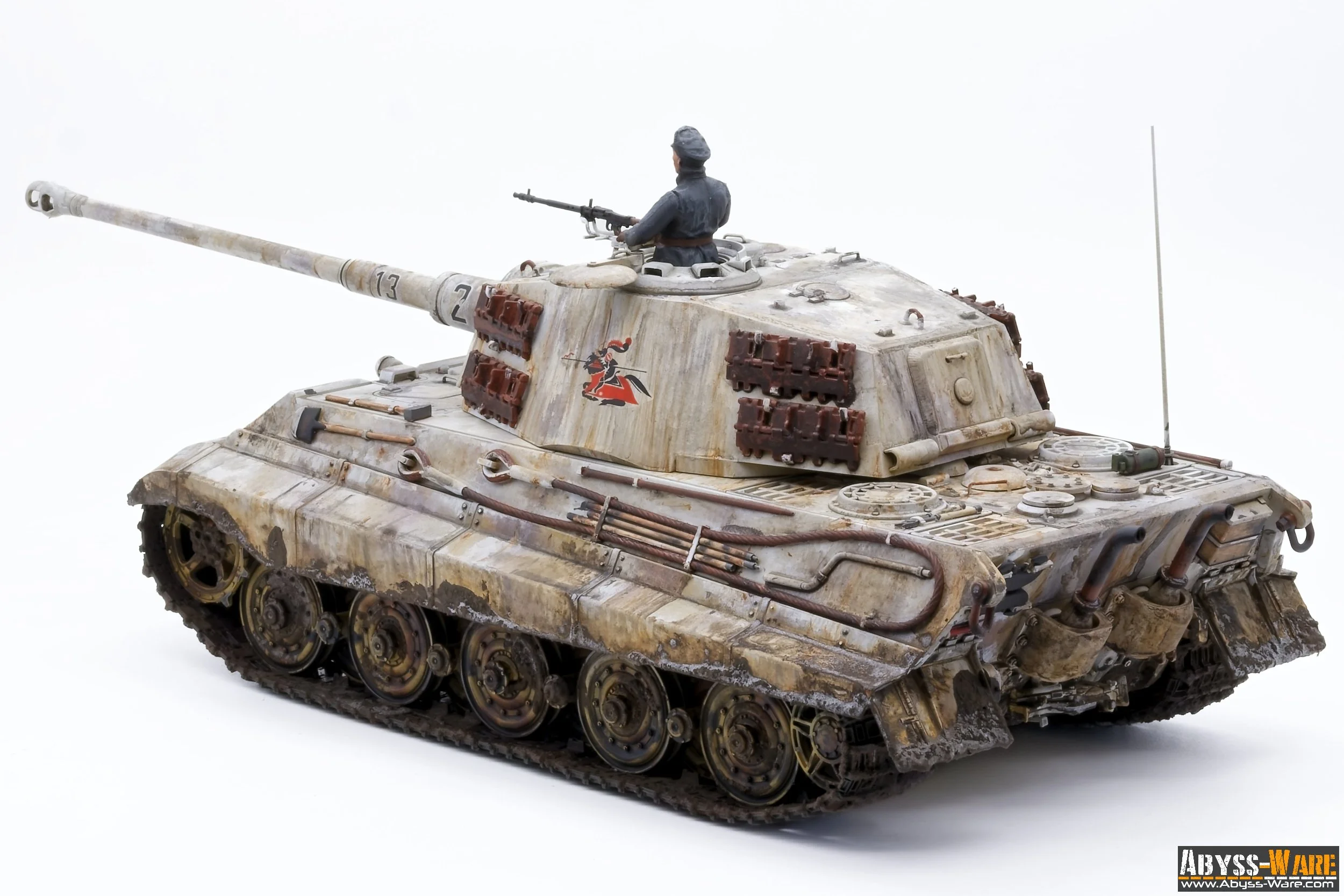
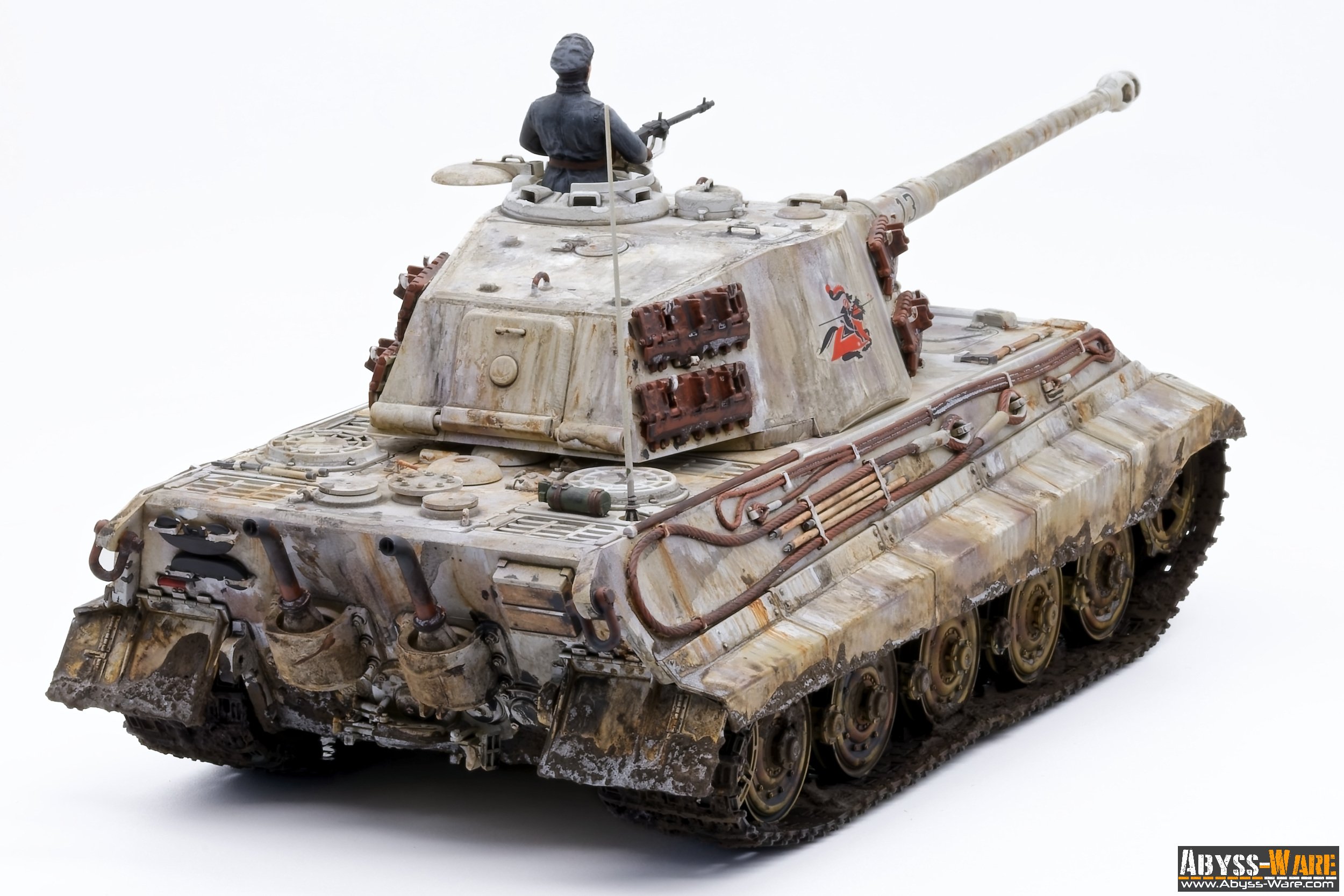
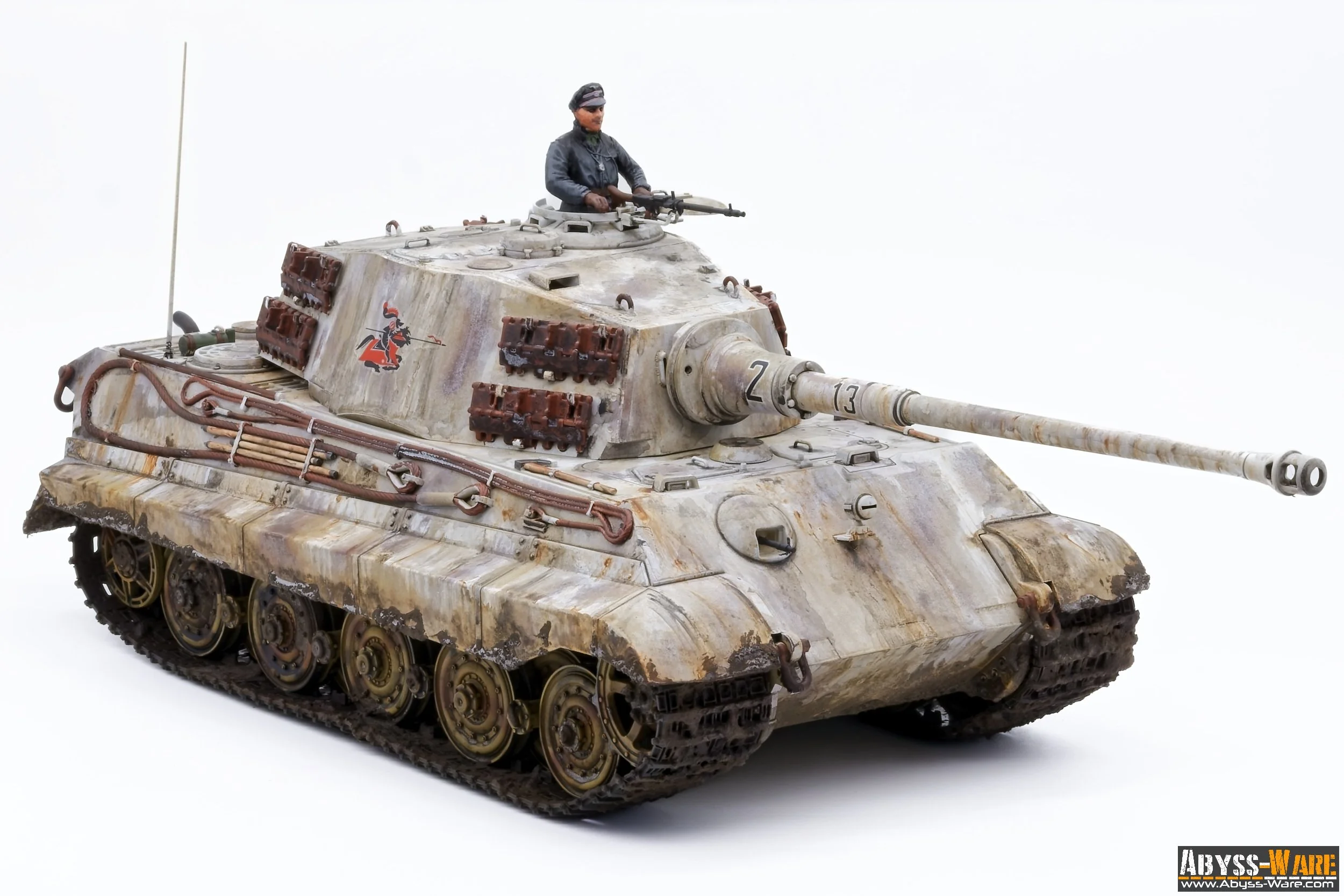
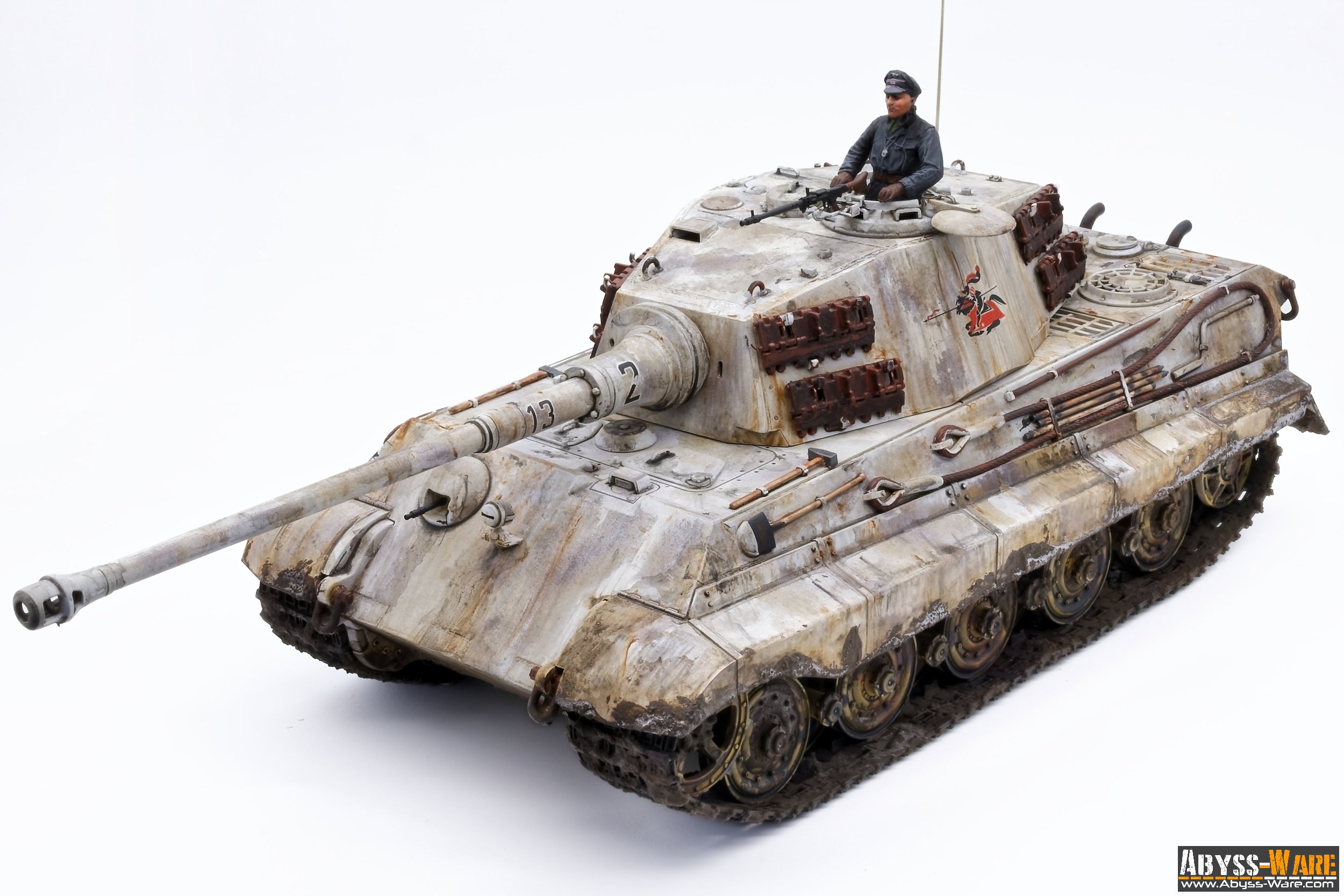
Königstiger: The King Tiger – Germany’s Pinnacle Heavy Tank of World War II
The Panzerkampfwagen Tiger Ausf. B, better known as the Tiger II or Königstiger (King Tiger), stands as one of the most iconic and formidable armored vehicles of the Second World War. Weighing nearly 70 tonnes, protected by up to 185 mm of sloped armor, and armed with the devastating 8.8 cm KwK 43 L/71 gun, it represented the apex of German tank design philosophy: overwhelming firepower and near-impenetrable frontal protection. Yet, its operational history was marked by mechanical unreliability, logistical nightmares, and production constraints that limited its strategic impact. Produced in only about 492 units between 1944 and 1945, the Königstiger arrived too late and in too few numbers to alter the war’s outcome, but it left an enduring legacy as a symbol of engineering ambition and tactical excellence.
Historical Context and Origins
By the early 1940s, the German Wehrmacht faced evolving threats on the Eastern Front. Soviet T-34 and KV-1 tanks, with their sloped armor and effective 76.2 mm guns, had exposed vulnerabilities in earlier German designs. The Tiger I (Panzerkampfwagen VI Ausf. E), introduced in 1942, restored qualitative superiority with its 8.8 cm KwK 36 L/56 gun and thick armor, but it was a rushed "emergency" solution using components from multiple projects. It suffered from high maintenance demands, narrow tracks causing high ground pressure, and production bottlenecks. German planners sought a true successor: a heavy tank with superior armor protection against anticipated Soviet upgrades (like the IS series), longer-range firepower, and better ballistic shaping through sloping. Development traces back to 1937 with Henschel contracts, but serious work accelerated in 1941–1942. Porsche and Henschel competed, with Krupp responsible for the turret. Porsche’s early efforts, including the VK 45.02 (P), featured innovative but problematic elements like gasoline-electric drives (similar to the Ferdinand/Elefant) and different suspension. These faced reliability issues, leading to cancellation. Henschel’s VK 45.03 (H) design, refined to incorporate Panther II components where possible, was selected. The first prototype (V1) appeared in late 1943, with production starting in January 1944 at Henschel’s Kassel plant. Hitler took keen interest, demanding the long 8.8 cm KwK 43 (derived from the Flak 41) for superior penetration. The tank was informally dubbed Königstiger by the Reichsministerium für Bewaffnung und Munition around late 1944. Allies often called it King Tiger or Royal Tiger.
Design and Technical Specifications
The Tiger II combined the Tiger I’s heavy armor ethos with the Panther’s sloped protection for improved efficiency.
Dimensions and Weight:
Mass: 68.5 tonnes (early turret) to 69.8 tonnes (production turret).
Length: 7.38 m (hull); 10.286 m (with gun forward).
Width: 3.755 m.
Height: 3.09 m.
Ground clearance: 495–510 mm.
Ground pressure: Approximately 0.76 kg/cm².
Armor: The Königstiger featured rolled homogeneous armor with excellent quality but varying thickness and angles:
Hull front (glacis): 150 mm at 50° (effective thickness significantly higher due to slope).
Hull sides: 80 mm (upper) at angles.
Hull rear: 80 mm.
Turret front (production): 180 mm (flat on later models, eliminating shot traps).
Turret sides/rear: 80 mm.
Roof: 40 mm (some early sections 25 mm).
Mantlet: Thick cast section.
This made the frontal arc extremely resistant. Most Allied tank guns (e.g., Sherman 76 mm, British 17-pounder at certain ranges) and many anti-tank guns struggled to penetrate from the front beyond point-blank distances. Side and rear protection was less formidable, making flanking maneuvers or close-range engagements critical for opponents. Zimmerit anti-magnetic mine paste was commonly applied.
Armament Main gun: 8.8 cm KwK 43 L/71 (71 calibers long). This high-velocity gun was one of the best tank cannons of the war.
Muzzle velocity: Over 1,000 m/s with armor-piercing rounds.
Ammunition: 80–86 rounds (early turret ~80; production ~86). Types included PzGr. 39/43 (APCBC), PzGr. 40/43 (APCR, tungsten core), and SprGr. 43 (HE). HEAT rounds were also available.
It could reliably engage and destroy most Allied tanks (Shermans, T-34s, Cromwells) at ranges exceeding 2,000 meters, often before they could effectively reply. Accuracy was excellent with the Turmzielfernrohr 9d sight.
Secondary armament: Two (sometimes three) 7.92 mm MG 34 machine guns (coaxial, hull, and optional cupola). Ammunition: ~5,850 rounds. A machine-pistol port was present in the turret.
Mobility and Powerplant
Engine: Maybach HL 230 P30 V-12 petrol, 700 PS (515 kW) at 3,000 rpm (often derated in practice). Same as Panther and Tiger I but over-stressed by the heavier vehicle.
Power-to-weight: ~10 PS/tonne.
Transmission: Maybach OLVAR OG 40 12 16 B (8 forward, 4 reverse).
Suspension: Torsion bar with 9 overlapping 800 mm steel-tired road wheels per side (no full interleaving like Tiger I to ease maintenance).
Tracks: Wide battle tracks; narrower transport tracks for rail.
Maximum speed: 41.5 km/h (road, short bursts); sustained ~38 km/h road; 15–20 km/h cross-country.
Range: Road ~190 km; cross-country ~120 km (often less in practice due to fuel consumption). Fuel capacity: 860 liters. High consumption (~487 liters/100 km in some reports) was a major issue.
The tank was surprisingly maneuverable for its size when operational, with good steering via the Henschel L 801 system, but final drives and transmission were prone to failure under the weight and stress. Fording depth was initially ambitious but reduced to ~1.8 m. Two sets of tracks were standard.
Crew and Ergonomics: Crew of 5: commander, gunner, loader, radio operator (hull MG), driver. The interior was relatively spacious for a heavy tank, with good optics and powered traverse (hydraulic, variable speed up to ~19–36°/second depending on engine rpm). Manual traverse was possible but slow. Command variants had extra radios (reduced ammo).
Turret Variants
Early (Krupp VK45.02(P2) style, ~50 units): Curved front, shot trap potential, commander’s cupola bulge.
Production (Serien-Turm): Flat 180 mm front, simplified manufacturing, more internal space, no major shot trap.
Production and Logistics
Henschel produced all hulls in Kassel, with Krupp supplying turrets. Total output: ~492 vehicles (1 in 1943, 379 in 1944, 112 in 1945). Plans for 1,500 were slashed by Allied bombing (e.g., raids destroying much of the factory in September–October 1944), material shortages, and prioritization of other weapons. Unit cost: ~321,500 Reichsmarks – the most expensive German tank. Quality was high initially but declined with wartime pressures (e.g., use of slave labor, material substitutions). Spares were chronically short. The 70-tonne weight strained bridges, rail transport, and recovery vehicles (often requiring multiple Tigers or specialized gear). Fuel shortages crippled operations in 1944–45. Many losses were from abandonment or self-destruction due to breakdowns rather than enemy action.
Combat History
The Tiger II debuted in Normandy with schwere Panzer-Abteilung 503 (s.Pz.Abt. 503) in July 1944. Early actions saw mixed results: impressive kills but frequent mechanical failures and vulnerability to airpower and flanking. One notable early loss involved a PIAT or 6-pounder in the Arnhem area.
Western Front: Limited numbers in the Ardennes Offensive (Battle of the Bulge). Units like s.SS.Pz.Abt. 501 suffered from fuel and bridge issues. A famous single Tiger II (possibly commanded by Lt. Michael Wittmann or associates) achieved kills but was eventually lost. Overall, they inflicted disproportionate casualties when mobile but were often static or abandoned.
Eastern Front: More extensive use against Soviets. s.Pz.Abt. 505 and others claimed hundreds of kills (e.g., over 1,700 tanks/guns by some battalions cumulatively). In Hungary (Budapest area), s.Pz.Abt. 503 claimed strong results (121 tanks, etc., for 25 losses). However, Soviet IS-2s, SU-152s, and massed artillery/ air attacks took a toll, especially on sides/rear. Long-range engagements favored the Königstiger.
Units equipped included s.Pz.Abt. 501–510, SS equivalents, and ad-hoc formations. By war’s end, most were destroyed or scuttled. Claims were high in defensive or ambush roles, but strategic impact was negligible due to numbers and logistics. Crew accounts praised the gun and armor but criticized reliability. Recovery was difficult; crews often blew up immobilized vehicles.
Comparisons with Contemporary Tanks
vs. Tiger I: Better sloped armor, longer gun, but heavier and less reliable.
vs. Panther: Superior armor/gun; Panther was lighter, more mobile, produced in greater numbers (~6,000).
vs. Allied: Outclassed Shermans, Churchills, and T-34/85 frontally at range. Vulnerable to 17-pounder Firefly, Pershing, or IS-2 at sides/close range. IS-2’s 122 mm gun offered heavy HE punch and side penetration potential.
vs. Soviet IS-2: Comparable in some duels; Tiger II superior optics/gun accuracy, but IS-2 more mobile and produced in thousands.
The Königstiger excelled in long-range, hull-down defensive positions but struggled in fluid offensives or contested logistics.
Legacy and Surviving Examples
Postwar, surviving Tiger IIs were studied by Allies. Several remain:
The Tank Museum (Bovington, UK) has a production turret example.
Others in Germany, Belgium, France, Switzerland (under restoration), Russia, and the US. One Porsche-turret prototype (V2) is notable.
Analysis and Conclusion
The Königstiger was a masterpiece of firepower and protection but a strategic failure. Its development prioritized quality over quantity at a time when Germany needed mass. Mechanical issues (overloaded components, fuel thirst), bombing disruptions, and Allied material superiority doomed it. Tactically, when crewed by veterans in favorable terrain, it was terrifyingly effective. Operationally, it drained resources better allocated elsewhere. Today, it reminds us of the trade-offs in armored warfare: protection, firepower, and mobility are rarely balanced perfectly under wartime constraints. The Königstiger’s roar may have been brief, but its legend endures.
The operational career of the Tiger II, or Königstiger, spanned roughly ten months from its combat debut in July 1944 to the end of the war in May 1945. Despite limited production (approximately 492 units) and persistent mechanical challenges, the tank demonstrated exceptional lethality in defensive and ambush roles when operational. Its 8.8 cm KwK 43 L/71 gun and thick frontal armor allowed it to dominate long-range engagements, often destroying enemy armor at ranges of 2,000–3,000 meters before opponents could effectively respond. However, its 68–70 tonne mass, high fuel consumption, fragile final drives, and vulnerability to air attack, flanking maneuvers, and logistical shortages led to many losses through breakdowns and abandonment rather than direct combat. Heavy tank battalions (schwere Panzer-Abteilungen, s.Pz.Abt.) typically received 45 Tiger IIs each (three companies of 14 plus headquarters vehicles). These independent units were shuttled between critical sectors. Key formations included s.Pz.Abt. 501, 503, 505, 506, and their SS counterparts. Below is a detailed chronological and theater-by-theater account drawn from unit histories, after-action reports, and postwar analyses.
Normandy and the Western Front Debut (July–September 1944)
The Tiger II first saw combat with the 1st Company of s.Pz.Abt. 503 during the Battle of Normandy. On or around 18 July 1944, opposing the Canadian Operation Atlantic near Troarn and Demouville, the unit engaged Allied forces amid the intense fighting following D-Day. Two Tiger IIs were lost in direct combat, while the company commander's vehicle became irretrievably trapped in a large bomb crater from preceding Allied bombardments (linked to Operation Goodwood). Early performance was mixed. The tanks showcased superior firepower and protection in favorable conditions, but mechanical issues (especially final drives) and Allied air superiority hampered mobility. s.Pz.Abt. 503, partially equipped with Tiger IIs alongside remaining Tiger Is, faced heavy losses from fighter-bombers and naval gunfire. One notable incident involved a Tiger II knocked out southeast of Oosterbeek during Operation Market Garden (Arnhem, September 1944) by a British PIAT after prior damage from a 6-pounder anti-tank gun. Mortar fire penetrating engine decks in urban fighting highlighted vulnerabilities in top armor. s.SS.Pz.Abt. 501 (formerly equipped with Tiger Is) received its first Tiger IIs in August 1944. In actions around Guitrancourt and Melier, they destroyed Shermans but suffered losses to tank destroyers and anti-tank guns. One was lost at Meulan after repeated hits, and another rolled over evading air attack. These early Western engagements revealed the tank's strengths in open or hull-down positions but exposed weaknesses in fluid, close-quarters, or air-contested environments.
Eastern Front Introduction and the Sandomierz Bridgehead (August 1944)
The first major Eastern Front deployment occurred with s.Pz.Abt. 501 in mid-August 1944, countering the Soviet Lvov–Sandomierz Offensive. The unit attacked the Soviet bridgehead over the Vistula River near Baranów Sandomierski. On the road to Oględów (Ogledow), three Tiger IIs were ambushed and destroyed by T-34-85s from the 53rd Guards Tank Brigade. Side hits caused turret ammunition fires, leading to catastrophic explosions and crew fatalities. As a direct result, crews were ordered not to stow main gun rounds in the turret, reducing capacity from ~80–86 to 68 rounds. Up to 14 Tiger IIs from the battalion were lost or captured between 11–14 August in sandy terrain ill-suited to the heavy tank. Soviet forces, including T-34-85s, IS-2s, and ISU-122s, exploited flanks and close-range ambushes. Three operational Tiger IIs were captured, providing valuable specimens for testing at Kubinka. This debut exposed logistical and terrain-related vulnerabilities but also confirmed the gun's effectiveness when ranges favored the Germans. Other units like s.Pz.Abt. 505 and 506 were refitted and committed, suffering similar initial teething problems but achieving better results in more coordinated actions.
Hungary: Operations Panzerfaust, Debrecen, and Budapest (October 1944–Early 1945)
The Tiger II arguably found its most successful operational phase in Hungary with s.Pz.Abt. 503. Refitted with 45 Tiger IIs by September 1944, the battalion played a key role in Operation Panzerfaust (15 October 1944), supporting Otto Skorzeny's forces in securing Budapest and preventing Hungary's defection from the Axis. Tiger IIs operated in urban and semi-urban settings, providing mobile firepower. In the subsequent Battle of Debrecen (October 1944), the battalion operated in battle groups, achieving significant success. An after-action report dated 22 November 1944 praised the Tiger II highly: vehicles survived up to 20 hits without disablement; the 8.8 cm gun destroyed T-34s at 3,000 m and IS-2 ("Stalin") tanks at 1,500 m. From 19–23 October, the unit claimed 120 anti-tank guns, 19 artillery pieces, and contributed to disrupting Soviet forces. Over 166 days in Hungary, s.Pz.Abt. 503 accounted for at least 121 Soviet tanks, 244 anti-tank guns/artillery pieces, five aircraft, and a train, at the cost of 25 Tiger IIs (10 knocked out, 13 blown up by crews to prevent capture, two returned for overhaul). The report noted: "The Tiger II has proven itself in every way and is a weapon that the enemy fears. When employed as a single, unified entity... it always brings decisive success." This period highlighted the tank's value in breakthrough and exploitation roles when supported by infantry and in suitable terrain. The unit remained engaged in relief attempts for Budapest (Operations Konrad) into early 1945, continuing to inflict losses despite mounting Soviet pressure.
Ardennes Offensive (Battle of the Bulge, December 1944–January 1945)
Approximately 150 Tiger IIs - nearly a third of total production - were committed across four heavy battalions, with s.SS.Pz.Abt. 501 (attached to Kampfgruppe Peiper of the 1st SS Panzer Division) being the most prominent. Nominal strength for 501 was 45 tanks, though only about 37 started the offensive due to mechanical issues. The offensive began on 16 December 1944. Tiger IIs spearheaded advances but faced severe challenges: narrow roads, bridges unable to support their weight, fuel shortages, and difficult forested terrain that limited the long gun's traverse. Many broke down early; for example, Tigers 202 and 203 of the 2nd Company failed before reaching Bullingen. In Stavelot and surrounding areas, s.SS.Pz.Abt. 501 engaged U.S. forces. One Tiger II (possibly 222) was involved in actions near bridges over the Ambleve. Several were lost to air attack, anti-tank fire, or abandonment when fuel ran out. At La Gleize, Peiper's force, including Tigers, was encircled and forced to abandon equipment. Overall, most of the 150+ Tiger IIs were lost during the offensive - many to mechanical failure, fuel exhaustion, or scuttling—though they inflicted disproportionate casualties in direct clashes.
Final Battles on the Eastern Front (January–May 1945)
Tiger IIs continued fighting in the Vistula-Oder Offensive, East Prussian Offensive, Lake Balaton Offensive (Operation Spring Awakening, March 1945), Seelow Heights, and the Battle of Berlin. s.SS.Pz.Abt. 503 (later Feldherrnhalle) claimed around 500 kills from January to April 1945 for the loss of 45 Tiger IIs, most abandoned due to breakdowns or fuel shortages. In defensive or counterattack roles, the tanks excelled when hull-down or in ambush, leveraging superior optics and firepower. However, overwhelming Soviet numerical superiority, combined with fuel and spare parts shortages, rendered them increasingly static. Last-ditch defenses, such as near the Henschel factory in Kassel (April 1945), saw small numbers of Tiger IIs with hastily trained crews in final stands.
Overall Assessment of Combat Effectiveness
German records and unit claims indicate high kill ratios in favorable conditions. Examples include long-range destruction of T-34s, IS-2s, and Allied mediums. Crews praised the armor (frontal immunity to most threats) and gun accuracy. However, only a fraction of built Tiger IIs were operational at any time due to maintenance demands. A significant percentage of losses (estimates around 50–57%) stemmed from non-combat causes: mechanical failure, abandonment, fuel shortages, and demolition to avoid capture. Allied and Soviet countermeasures emphasized air power, artillery, flanking, and massed assaults. Captured examples informed enemy tactics and postwar designs. Tactically formidable, the Königstiger symbolized late-war German engineering prowess but underscored the impossibility of quality overcoming material and logistical inferiority on a strategic scale.